
National Gallery of Ireland
Ends October 2026; free admission
By Donal Fallon
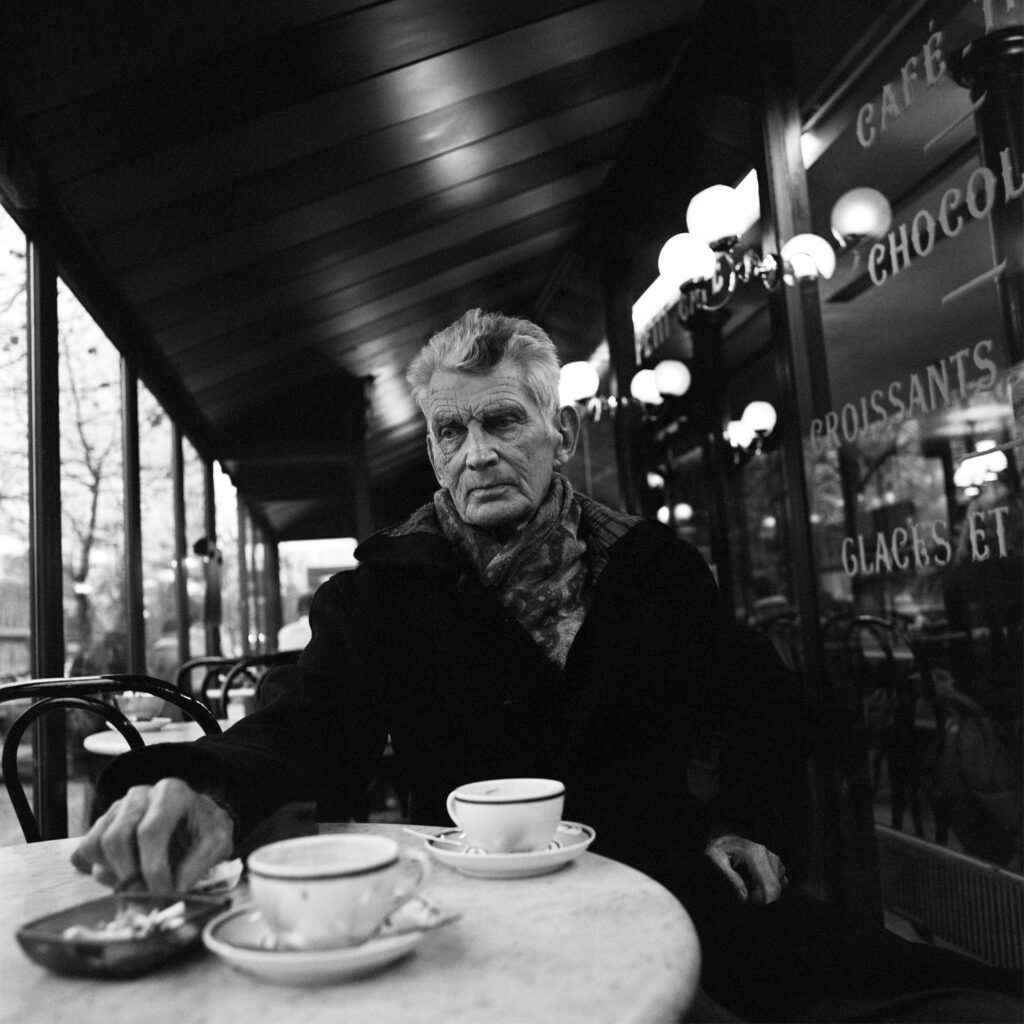
Last April I went on a sort of Beckett pilgrimage across Paris. There was Montparnasse Cemetery, smaller but no less rewarding than the celebrated Père Lachaise. Simone de Beauvoir and Serge Gainsbourg may bring more visitors to Montparnasse, but there was plenty of evidence of pilgrimage at the grave of Sam and his wife Suzanne. For the most part, though, to seek out the Paris of Beckett is to walk in the footsteps of John Minihan. In an interview with the Guardian, Minihan recounted the day he photographed Beckett at his local café in Montparnasse at 3pm on a Sunday. After almost two hours of talking, Beckett asked Minihan whether he’d like to take his photograph: ‘I got out my Rolleiflex and took three frames. They turned out better than I expected because Sam directed the whole scene.’
Minihan’s images of Beckett are perhaps more familiar to the Irish public today than Beckett’s own work. Indeed, as Ciaran Carthy contends in Intimacy with strangers: a life of brief encounters, they are ‘surely among the most iconic images of the twentieth century’. Yet, to understand how Minihan gained such access to Beckett, it is Athy and not Paris that holds the key.
Visual Poetry: The Photography of John Minihan is an exploration of both the familiar and the unfamiliar work of one of the defining photographers of modern literature. Housed in the small Sir Hugh Lane Room, it is an exhibition of some 30 wall-hung works and some personal objects in display cases. There will be two rotations during the run, bringing new work before the public. The exhibition begins with a potted biography of Minihan, who was born in Dublin in 1946 but raised in Athy and London, where a darkroom apprenticeship at just fifteen years of age in the Daily Mail was his introduction to photography in a commercial sense.
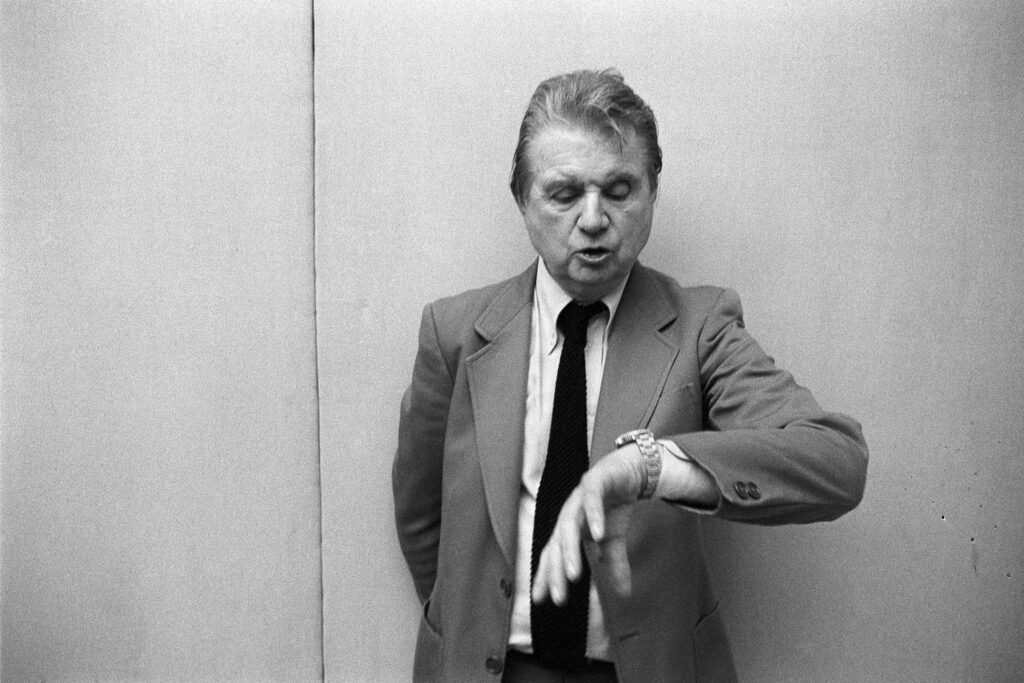
Many will come to see the exhibition on the strength of Minihan’s portraits of writers and artists. Anyone who has seen a copy of the much-celebrated book An unweaving of rainbows: portraits of Irish writers will know the extraordinary breadth of literary talent photographed by Minihan, from journalist Con Houlihan to poet Derek Mahon, and from novelist Edna O’Brien to Nobel Prize laureate Seamus Heaney. Here we encounter works less familiar to Irish eyes, including striking images of Andy Warhol. After his images of Beckett, Minihan is undoubtedly most closely associated with Francis Bacon, and here we see images of the artist at London’s Marlborough Gallery. Later invited to photograph his Reece Mews studio—now reassembled in the Hugh Lane Gallery—Minihan recalled leaving Bacon’s sacred space and how ‘I knew I was among the privileged to be invited to his private chamber, where he allowed no one to observe or document the artist at work’.
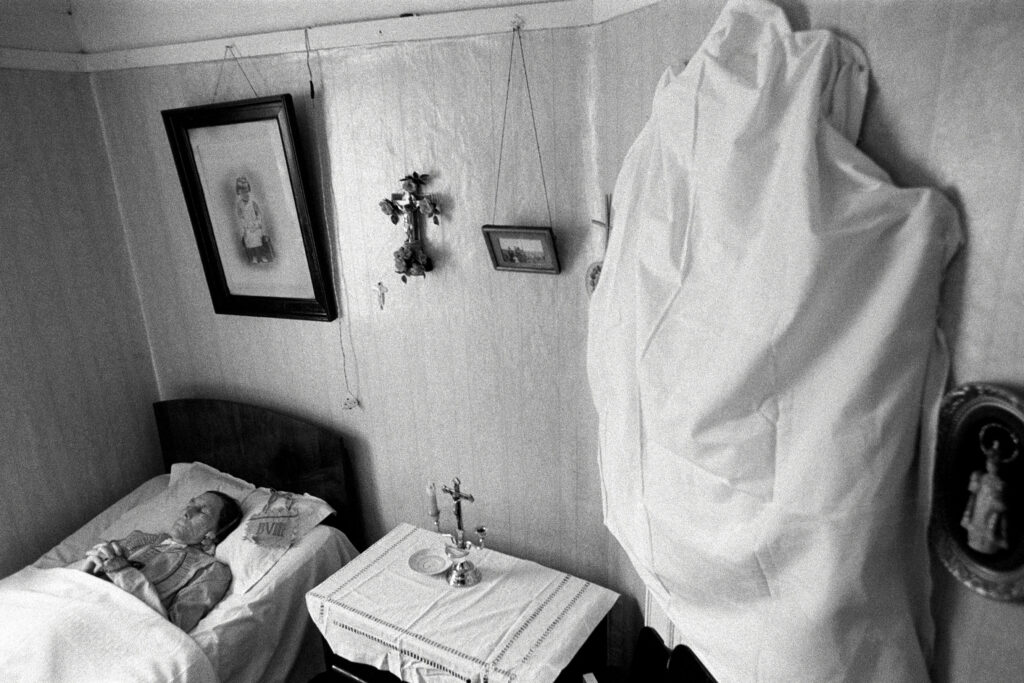
Minihan as a photographer of artistic genius is familiar to us, but as a chronicler of social history and changing customs he produced images that capture societies in extraordinary ways. In one panel he explains that it was ‘a privilege to grow up in Athy during the age of belief’, and that fascination has brought him to interesting places. We see images of religious pilgrimage in Havana, with Minihan particularly interested in the annual pilgrimage to the San Lazaro sanctuary in El Rincón (San Lazaro being the patron saint of the sick and poor). It was a religious tradition in Ireland, in the form of the communal wake, that transformed Minihan’s career. When visiting Athy in 1977, he was invited by a local family to photograph the wake of Katy Tyrrell. Taken over three days and two nights, these images capture an important and time-honoured Irish ritual. When Minihan secured access to Samuel Beckett in the Hyde Park Hotel (thanks in no small part to an Irish porter), he presented to Beckett his photographs of Athy, including The Wake of Katy Tyrrell. In an interview later, Minihan spoke of how Beckett was someone who ‘understood the camera, light and shade. When you go to see his plays, they are just beautiful plays to photograph for a black and white photographer like myself.’
Throughout his career, John Minihan has photographed largely (almost but not entirely exclusively) in black and white. Every image presented here is thus, while emblazoned across the wall are his words insisting that ‘Black and white are the colours of photography’. Minihan has been a vocal critic of the colourisation of historic images, even describing it as ‘a form of vandalism’. He allows his images to speak for themselves; when asked by the Irish News whether he was ever inspired to write about his work, he insisted that ‘the photograph already tells its story, as the poetry is in the picture and the narrative is there as well’.
In the centre of the room, display cases include working photographer passes from Minihan’s career with newspapers, but also some excellent newspaper clippings. An Evening Press report on a Francis Bacon exhibition includes words from Fr Donal O’Sullivan, once president of the Arts Council, who would describe a Bacon show as an ‘almost nauseating experience … it hit one in the entrails, in the blood, and only much later in the brain’.
As a photographer, John Minihan has had a defining impact on those who have followed him. In the most recent AIB Portrait Prize exhibition, a striking image from Waterford photographer John Foley showed a ‘Biddy Boy’, as those who parade through the streets of Killorglin each year are known. Like Minihan’s works from Havana and Athy, the shot demonstrates a keen observational sense and respect for the culture before it. In Irish portraiture broadly, the endurance of black and white owes something to Minihan too. He is a rightly revered figure in his field, and this exhibition provides a perfect introduction to his work and ideals.
Donal Fallon is a historian and the presenter of the ‘Three Castles Burning’ podcast.