
DERMOT KEOGH, OWEN McGEE and MERVYN O’DRISCOLL (eds)
Cork University Press
€49
ISBN 9781782050599
Reviewed by
Brian Hanley
The Palestinian historian Rashid Khalidi has argued that key to understanding the impact that Irish republicans made between 1919 and 1921 is that they ‘were led by people with a sophisticated understanding of the global balance of power, of the way imperial governments operate, and how to reach public opinion in the metropole’. In his view, ‘the Irish won in 1921’ because Michael Collins and Eamon de Valera ‘understood British and American politics, and had extensive political and intelligence operations there’. Leaving aside the question of whether or not the Irish ‘won’, it is fair to say that Khalidi’s enthusiasm for revolutionary diplomacy is little understood in Ireland today.
Global networking is not part of the popular conception of the War of Independence, and many are still loath to give de Valera credit for anything, but Irish revolutionaries were keenly aware that they had to broadcast their message to the outside world. Harry Boland stressed during 1920 that ‘left to ourselves in Ireland we cannot hope to win the final victory … To Australia, Canada, South Africa, India, Egypt and Moscow our men must go to make common cause against our common foe.’ It was not only the revolutionary élite who paid attention to the global scene. Woodrow Wilson’s ‘promise’ of self-determination (a phrase ‘loaded with dynamite’, as his cynical Secretary of State Robert Lansing warned) was referenced repeatedly by Sinn Féin at a local level in Ireland during the December 1918 general election. For some at least, there was a hope that international pressure might force Britain to concede Irish demands without further violence. Dáil Éireann’s Message to the Free Nations of the World is referenced less than the Democratic Programme these days, but it was just as important a document at the time. Indeed, the Democratic Programme, too, was adopted with at least one eye on its reception outside Ireland by the international socialist movement. Irish revolutionaries established more missions abroad during the revolutionary period than the independent Irish state was able to do for another 50 years. Far more women, such as the remarkable Katherine Hughes, were involved in this republican diplomacy than the Department of External Affairs subsequently employed for decades.
The United States was not only vital for fund-raising. The Dáil’s effort there was also crucial in undermining the British narrative about what was happening in Ireland. British diplomats, too, understood the need to contest Irish claims, especially in the United States, and deployed major resources in doing so. De Valera also campaigned in the teeth of an intense wave of post-war nativism. In that sense Irish achievements there were all the more remarkable. A wider propaganda war, in which the Dáil’s Irish Bulletin, ultimately translated into several European languages, played a key part, was waged across the British Empire and continental Europe.
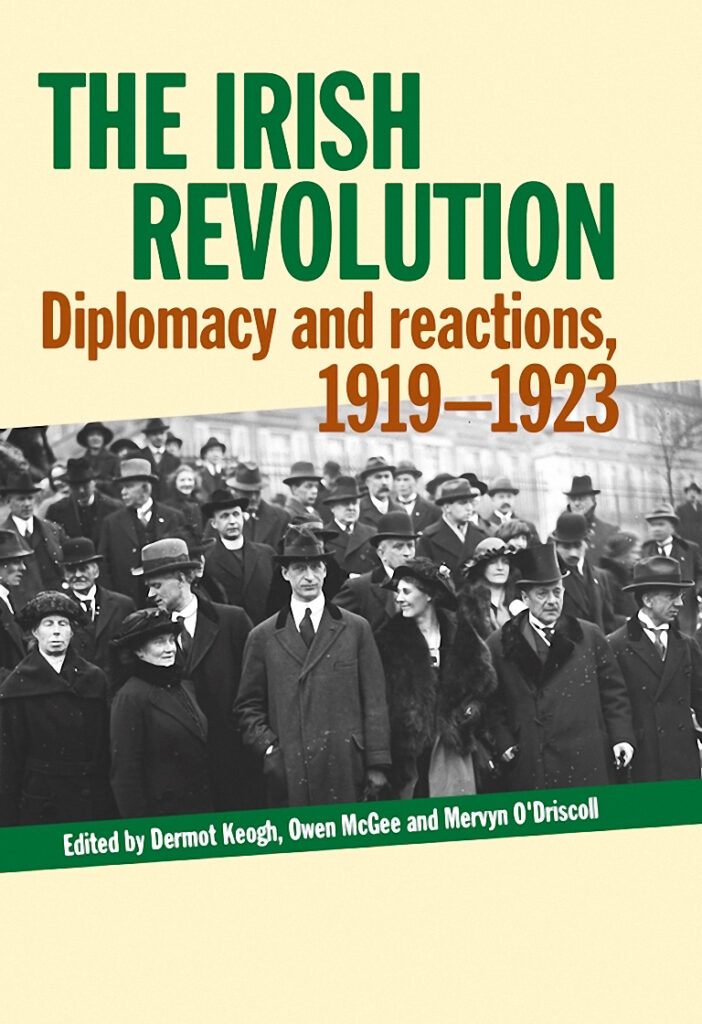
Dermot Keogh, who died in 2023, was a pioneer of Irish diplomatic history. This impressive collection is a fitting contribution to his legacy. The book’s foreword contains an affectionate tribute to Keogh from another leading historian of Irish foreign policy, Michael Kennedy. Keogh, with Owen McGee and Mervyn O’Driscoll, was a joint editor of this volume. He also contributed two chapters, reflecting interests in Italy and the Vatican. McGee’s introduction provides an overview of the very diverse range of topics explored in this collection. The United States features, of course, but so do South Africa, Australia and New Zealand, Russia, France, Germany, Spain and Austria-Hungary. Many of those contributing are specialists in their areas: Niall Cullen on the Basques, Jeff Kildea on Australia, Mary MacDiarmada on the Irish effort in Britain, Jérome aan de Wiel on the Austro-Hungarian empire and Aidan Beatty on Zionism. Alongside work by Lili Zách, Anna Lively, Robin Adams, Daragh Gannon, Niall Whelehan and Fearghal McGarry, this book adds significantly to a growing literature on the global aspects of the Irish revolution.
The chapters on Canada, Australia and New Zealand are particularly useful for illuminating the role of the ‘other’ Irish diaspora during this era. Irish Protestants, or their descendants, made up a sizeable part of the population of these countries, and, while some were not loyalist in politics, many were. In Australia Irish Catholics were blamed for the successful movement against conscription, while the fact that New Zealand’s premier, William Massey, was an Orangeman from County Derry surely influenced his view of the Irish question. Pádraig Ó Siadhail’s discussion of how Seán MacSwiney (of the Cork revolutionary family) resisted being conscripted in Canada helps illuminate attitudes towards Ireland there.
Irish republicans put a great deal of effort into campaigning in continental Europe and the volume’s focus on this is justified, but we could perhaps interrogate the story of the Continental imperial powers further. There were millions of Europeans who lived under foreign rule, from Ukraine to Bohemia and from Greece to Finland. Did their experience differ greatly from that of the Irish under British rule? In Ireland there is a tendency to assume that ‘our’ colonial experience makes us uniquely equipped to understand the travails of those whom Britain ruled in Africa or Asia. A discussion on this might be useful, as assumptions about colonialism in Ireland have never been more popular than at present. In the recent Dáil debates about fox-hunting, for instance, those supporting a ban described the ‘sport’ as a ‘colonial’ import. During the presidential election, candidates were appraised on the basis of their possession of allegedly ‘colonised’ or ‘uncolonised’ minds. Irish solidarity with global causes is regularly explained by reference to ‘our’ colonial past; there is an assumption that this solidarity is ‘instinctive’, but there is often very little engagement or, indeed, knowledge of how ‘we’ actually behaved in that colonial past. When Rabbi Joseph Krasukopf told the 1919 Irish Race Convention in Philadelphia that ‘Ireland would be free and ruled by the Irish just as Palestine would be free and ruled by the Jews’, he was cheered enthusiastically. Irish republicans had lauded Boer resistance to the British, to the extent of praising their record of defeating their ‘savage enemies—the Kaffirs and the Matabeles’. Republicans who opposed dominion status for Ireland still thought it appropriate and, indeed, ‘noble’ for places like Australia and New Zealand because the people there ‘sprung from England (and were) children of England’.
Several chapters in this book recount Irish attempts to rally support from Italian fascists, the Bolsheviks or the Vatican. These connections are noted rather matter-of-factly, but they do raise questions about whether this represented ruthless pragmatism by Irish republicans or perhaps just plain old cynicism. De Valera presented a largely secular view of his ideology to American audiences, while other republicans assured the Vatican that they represented ‘Catholics as deeply religious as any others in the world … as practising Catholics we have never allowed our national movement for independence to be contaminated by anti-religious or other dangerous movements condemned by the Church’. Others went further, with George Gavan Duffy telling potential supporters that the Irish fight for freedom was waged against the might of the ‘Jews and Masons’. More could have been said on the political attitudes of the revolutionary diplomatic corps—a diverse group certainly, but whose class and education may have pushed them closer to the political right in Europe than to the contemporary left. What did the courting of Mussolini say about nascent Irish attitudes to fascism, for example? Many of those with whom the Irish dealt in Germany were on the anti-Weimar right. Irishmen, former soldiers in Casement’s Irish Brigade, died fighting against the left in Munich during 1919, while at least one served with the Freikorps.
Several chapters refer to Irish Race Conventions but there is little consideration of the question of race itself. In the United States (and at times elsewhere) Irish republicans repeatedly asserted that they represented the ‘last white nation in slavery’. As America was in the midst of its most intense racial turmoil since the 1860s, this language was loaded to say the least. When de Valera toured the American South, knowing that opposition would come from nativists there, Liam Mellows suggested that he stress the Irish contribution to the Confederacy and laud John Mitchel in particular. African-American activists, such as W.E.B. Du Bois, supported the Irish cause despite their experience of Irish racism, but this generosity on their part was largely unreciprocated by the Irish. In Paris Seán T. O’Kelly complained about his lack of success in accessing the peace conference, lamenting that ‘it seems that the blacks and yellows, all colours and races, may be heard … except the Irish’. Irish separatists (and socialists) seem to have accepted without question right-wing German propaganda about the so-called ‘Black Horror on the Rhine’. Old Ireland, edited by P.J. Little, one of the most sophisticated republican journals, denounced the French government in 1920 for releasing ‘an army corps of black barbarians on the Palatinate, the homeliest and most civilised countryside in Europe’. But at the same time republicans also expressed great affinity with the Indian and Egyptian nationalist movements. Representatives of what republicans called their Indian and Egyptian ‘brothers in pain’ interacted in New York, London and Berlin. Previous work by Kate O’Malley and Michael Silvestri has illustrated how important these connections were. Contacts with these groups are mentioned in passing in this collection but they surely deserved further attention. The IRA gave military advice to both sets of revolutionaries, and Lloyd George feared the emergence of ‘a pan-Islamic Sinn Féin mischief making machine’ for good reason. Similarly, Sir Henry Wilson saw Britain’s fight as against ‘New York and Cairo and Calcutta and Moscow’, who were using Ireland as a ‘tool and lever against England’.
While the Dáil’s diplomatic corps worked hard to present Ireland’s case to European power brokers, Irish republicans also utilised more subterranean channels. Hundreds of men and women, from miners in Lancashire to criminals in London’s East End and numerous rogues and adventurers across Europe, were enlisted to help arm the revolution. The IRA was chronically under-armed and, while post-war Europe was awash with weapons, its quartermaster general, Seán McMahon, noted how ‘the purchase of materials is a simple matter compared with our transport difficulties’. Hence many Irish diplomats were adept at multi-tasking. As Dermot Keogh’s essay on Donal Hales notes, the Cork man was deeply involved in an effort to bring 20,000 rifles and 500 machine-guns to Ireland via the separatist ‘state’ of Fiume. The Cork IRA considered that these arms would constitute a game-changer, and rancour about the failure of the shipment festered for years. Several of those on Dáil work in Germany were also attempting to buy weapons there, including, somewhat ambitiously, a submarine. Frustrated by Cathal Brugha’s unwillingness to allocate funds for a large consignment of Thompson guns in the United States, Harry Boland set up a bogus Irish refugee fund to pay for them. This collection’s concentration on what might be called ‘official’ channels neglects this important part of republican global networking. Nevertheless, if a good test of a book is whether you learn something new from reading it, this volume certainly succeeds.
Brian Hanley is Assistant Professor in the History of Northern Ireland at Trinity College, Dublin.