
PÁDRAIG LENIHAN
Four Courts Press
€40
ISBN 9781801511728
REVIEWED BY
Chris Doyle
Chris Doyle is Lecturer in Medieval History at the University of Galway.
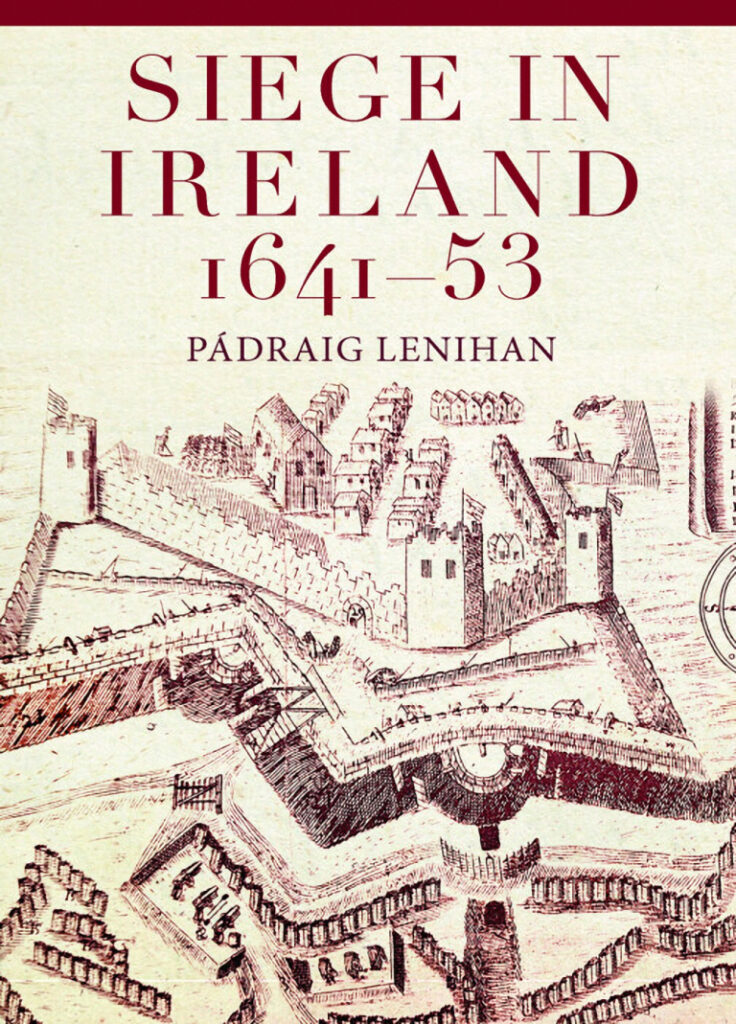
Ireland was torn asunder by violent conflict between the years 1641 and 1653. This prolonged era of war is known variously as the Cromwellian Conquest, the English Civil War, the Confederate Wars or, more generally, the War of the Three Kingdoms. It was a complex situation with multiple belligerents. There were several major battles involving infantry, cavalry and artillery—at New Ross, Rathmines and Scarrifholis, for instance—but it was siege warfare that ultimately defined hostilities. Virtually no Irish urban centre was untouched by siege, and it is this type of military operation that Pádraig Lenihan evocatively brings to life in this engaging book.
Towns and castles all over Ireland fell to siege in its various forms—surprise, betrayal, encirclement, blockade, storm, sack—and Lenihan discusses these different processes at length. Certain commanders preferred an all-guns-blazing approach. During his brief Irish sojourn, Oliver Cromwell ordered his soldiers to storm towns, resulting in enormous casualties on both sides. Under his watch, massacres of combatants and non-combatants happened at Drogheda and Wexford (1649). He was also responsible for thousands of his own men being killed at Clonmel (1650) owing to his insistence on a full infantry assault through the town’s breached wall. Lenihan’s description of these and other events points to Cromwell’s incompetence at siege warfare. By contrast, Eoin Dubh O’Neill’s successful defence of Clonmel forced Cromwell to offer the town relatively good terms when it did surrender. O’Neill was a siege warfare veteran, with years spent in Spanish service. Experience mattered when it came to sieges.
More calculating individuals such as the Parliamentarian officers Henry Ireton at Limerick (1650 and 1651) and Sir Charles Coote II at Galway (1651–2) viewed siege as a waiting game. Cutting off Limerick and Galway by land and sea, they caused famine, disease and death inside those towns. In such circumstances, defenders had to make heart-wrenching decisions. A common tactic for besiegers was to allow refugees access into a besieged settlement, as happened at Limerick and Galway. The sudden population increase put pressure on urban food and drinking-water supplies, causing contaminated sanitary conditions that led to disease outbreaks. When Limerick ejected hundreds of refugees, the so-called ‘useless mouths’, Ireton caught and hanged those unfortunates in full view of the town. Using Irish and English siege accounts, Lenihan adds similar contemporary European evidence to paint a ghastly picture of what people will resort to under siege. It seems that siege warfare was just as awful in seventeenth-century Europe as it was in Ireland. What is clear is that it was not just the besieged at risk of sickness, for besieging armies could also incur losses from illness. And their leaders were certainly not immune: Ireton himself died of plague at Limerick.
Lenihan’s study shows how the old Irish political order resisted its enemies until it eventually succumbed to the relentless military siege campaigns waged across the land. The tragic events outlined in this book significantly contributed to what was to come—English colonial subjugation of Ireland. It is why the period Lenihan covers here is still remembered from a distance and he delivers that story effectively, supplementing his clear prose with photographs, maps and tables. He intersperses his text with excerpts from contemporary testimonies (and later recollections) from survivor and perpetrator alike, some of which are incredibly harrowing. Though Lenihan does point to instances of mercy shown by individual commanders on site, these are rare. The take-away from most of the accounts he provides is that no one side was innocent, and a general order from the top often demanded that no quarter be given to captured enemy combatants.
Lenihan has written and lectured extensively on seventeenth- and eighteenth-century military history. Before his academic career he served as an artillery captain in the Irish army, and he has visited many historical siege and battle sites in Ireland and abroad. This combined experience affords him a unique perspective on the realities of early modern siege warfare—from organisation to implementation. He has a methodological and practical approach to the primary source materials that he consulted and used for this book, the culmination of which is a deeply contemplative journey for the reader into a dark and difficult chapter from Ireland’s past.
The events of the 1641–53 war presented in Lenihan’s book had a profound impact on the course of Irish history, society and culture. Though it happened centuries ago, the trauma of that conflict is buried deep in the Irish psyche. Its physical scars are visible also in the landscape. Broken, lonely castles littering the countryside, fragments of town walls and scarred churches all bear testimony to that long-ago Irish catastrophe. As one anonymous seventeenth-century Irish poet put it, Ag so an cogadh do chriochnaigh Éire ’s do chuir na milte ag iarri dearca … Do rith plaig is gorta in aonacht [‘This was the war that finished Ireland and put thousands begging … Plague and famine ran together’].