
By Cora Crampton
‘Whenever the Irish past is invoked, we must ask ourselves not only by which groups and to what end, but also against whom?’ (Ian McBride)
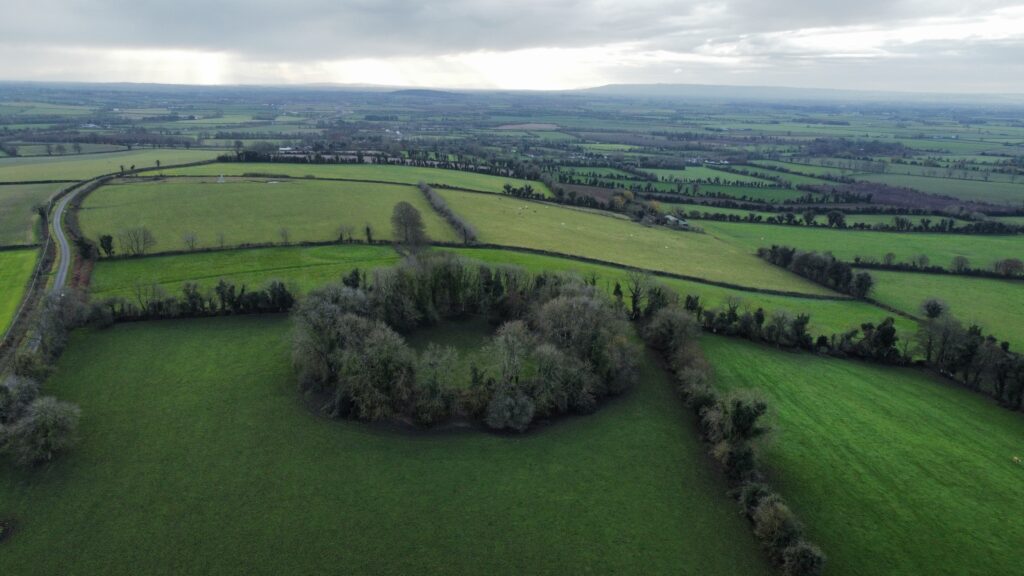
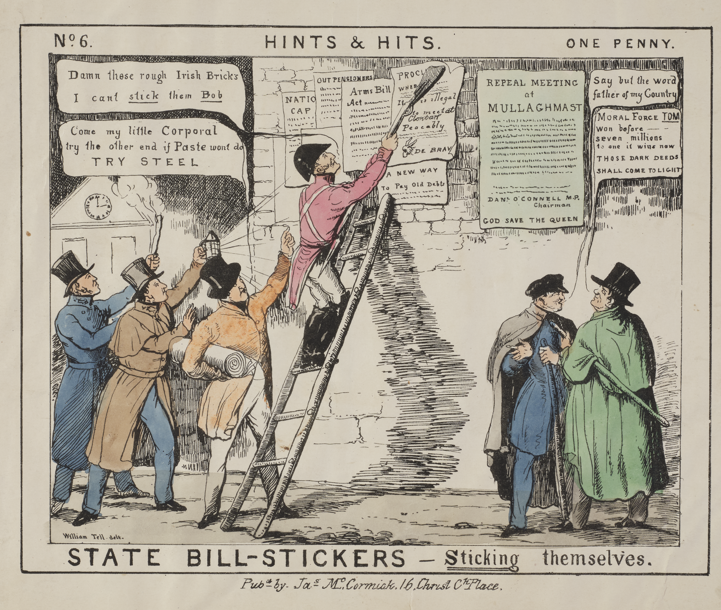
The people of Leinster travelled in their many thousands to the rath of Mullaghmast in south Kildare, close to the village of Ballitore, on 1 October 1843 to participate in what would be the last ‘monster’ meeting of Daniel O’Connell’s ‘great Repeal year’. During 1843 up to 40 large-scale rallies were held across Ireland as part of O’Connell’s strategy of pressuring the British government into repealing the Act of Union of 1801. The rath of Mullaghmast was selected as the venue for the second in a trio of especially large ‘monster’ meetings. The site’s traumatic sixteenth-century past was resuscitated and reimagined to influence the contemporary political concerns of 1843. Mullaghmast was an example of a carefully orchestrated and richly symbolic performative public and cultural event. As to the size of the crowd, estimates varied from 250,000 to one million people.
HISTORY AND NATION-BUILDING
Mullaghmast had been preceded by the monster meeting at Tara, Co. Meath, in August and should have been followed on 8 October by the final meeting of 1843 at Clontarf. At Tara a particular historical memory was revived; the hill was chosen because it had once been ‘the site of the royal palace … where the Ardrigh and sub-kings of Ireland had met in council’. Clontarf was chosen because it was the site where Brian Boru had defeated his enemies. Mullaghmast was selected because of its connection with an infamous massacre of members of the native Irish élite during the sixteenth-century Tudor reconquest.
The sixteenth-century atrocity at Mullaghmast had its origins in the intensely violent clash between English and native Irish during the colonisation of the midlands. Contemporary Irish sources for the massacre survive but differ as to the number of victims, which may have been as high as 400. Evidence indicates that on 1 January 1577/8 a party of native leaders from Queen’s County were invited to attend a parley at the ‘great Rath of Mullagh-Maistean’. Once assembled there, the unsuspecting and unarmed Irish leaders were summarily slaughtered by English and native Irish forces with the tacit approval of Lord Deputy Sir Henry Sidney. The victims had been deceived, having been summoned there ‘under protection’. The perpetrators were condemned for flying in the face of standard military practice and contemporary conventions of good faith.
The early decades of the nineteenth century saw growing interest and advances in Irish antiquarian studies, often in the cause of nation-building. O’Connell realised that Mullaghmast’s early modern past could prove useful. It aligned with the immediate objectives of Repeal and those of the nationalist press, especially of the young men of The Nation. This newspaper, founded in October 1842 by Charles Gavan Duffy, John Blake Dillon and Thomas Davis, provided Repeal with a very effective publicity machine at a time when mass communication was in its infancy. The Nation pursued its own agenda of political and cultural nationalism but viewed O’Connell’s movement as the most effective means of politicising the people. The newspaper’s editors had little interest in history for its own sake, but they possessed a keen understanding of the importance of history-writing in the forging of national self-awareness and distinctiveness; their stated aim was to ‘nationalise the public mind’.
Other nationalist newspapers were instrumental in galvanising the masses in advance of the Mullaghmast meeting, which was given an unprecedented amount of publicity. The Freeman’s Journal juxtaposed the purity and glory of Tara’s pre-English past with Mullaghmast’s blighted history:
‘Tara was typical of our condition before the enemy polluted the soil of this fair land. Mullaghmast is emblematic of that to which the hated rule of the oppressor has subdued us. Tara is the creation of the Irish mind, swayed by no anti-national influence. Mullaghmast is the realization of that state to which our trustfulness of others must reduce us.’
Why were historical narratives so important? Some of the insights of Benedict Anderson, a political scientist and historian who studied the origins of nationalism, may help answer this question. Anderson proposed that history, when plotted to suggest a continuous shared past involving a continuous shared struggle, became a unifying factor in the cause of nation-building. Characters such as the high kings of antiquity, Brian Boru and the chieftains of Laois entered and exited the Irish historical stage at different times in this repurposed national history. Yet what connected these historical characters and their milieu to each other? Anderson argued that essentially the connection between such figures was imagined. However, their utility in formulating and cementing a shared national identity was very real and helped to create a communal cultural code and a shared historical tradition of apparently serial continuity.
A LOCUS CLASSICUS OF BETRAYAL AND VICTIMHOOD
Such were the ideological needs of O’Connell and his associates that they disregarded Mullaghmast’s pre-Christian history, even though the rath had been an important place of royal assembly for the kings of Leinster up to the sixth century AD. Mullaghmast was not required to function as a locus classicus of Ireland’s glorious past; Tara was already performing this function. O’Connell and the nationalist press presented Mullaghmast as an archetype of English betrayal and Irish victimhood congruent with the unequal power relations that then existed between Ireland and Britain. Such motifs served to manipulate the past to justify a particular view of the present. They also provided a means of communicating cultural differences to bind together the recently imagined community of nationhood.
O’Connell forcefully invoked Mullaghmast’s history at the rath. His recurring narrative was that the Irish people should not allow themselves to be misled by the current British administration as their sixteenth-century ancestors had been deceived at Mullaghmast. He addressed the assembled crowds as follows:
‘… and here we are now, upon the Rath of Mullaghmast. I choose it for an obvious reason. We are upon the precise spot in which English treachery, aye, and false Irish treachery too, consummated a massacre … I thought this a fit and becoming spot to celebrate our unanimity in declaring in the open day, our determination not to be misled by any treachery.’
Because of the prior publicity, the masses were already familiar with Mullaghmast’s historical significance. What mattered most was not necessarily defined by the truth value of Mullaghmast’s past but by what it signified for O’Connell and his audiences. Frederick Engels, whose common-law wife was Irish, recognised the power of an agitation that drew on a deep sense of historical resentment.
A NATIONALIST INDOCTRINATION
Although the Processions Act (1832) forbade green flags and political banners during Repeal processions, the prohibition was imaginatively circumvented by the crowds en route to the rath. They pulled green branches and sometimes entire boughs from trees. This was an ingeniously subversive way of displaying the national colour, echoing the green sprigs worn by the United Irishmen. The greenery represented a form of symbolic resistance that, although lacking central coordination, provided the lower classes with a flexible means of acting collectively in public. Another discreet way of keeping to the letter of the law while evading its spirit was for men to wear their Repeal tickets in their hats, tied with green ribbons to their Repeal buttons or around their necks.
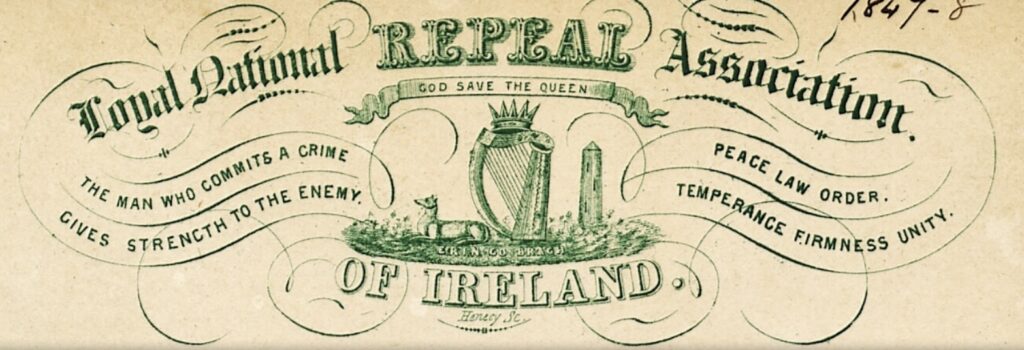
There was no shortage of ostentatious nationalist displays and ‘party’ flags at the site of the rath. A flag can condense into one concentrated image the history, the culture and the society of the group it represents. The iconography included the old Irish harp (with and without the crown). Many flags bore the words ‘Remember Mullaghmast’. This had become a popular slogan and was easy to recall. Indeed, the slogan had so captured the imagination of one journalist that he imagined that ‘along the whole road to Mullaghmast, at each step, on each house, on each tree, on each banner, the word “remember” was placed’. An archaeological survey conducted in the vicinity of Mullaghmast during 2007, prior to the construction of the M9 motorway, discovered several clay pipes emblazoned with the word ‘remember’.
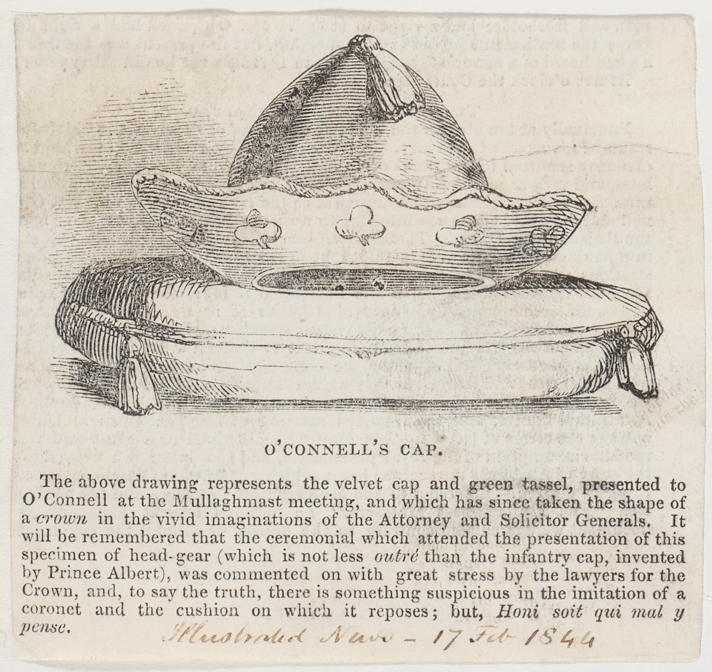
O’Connell was keenly aware of the propaganda value of the elaborate public gesture. One of the most enduring memories etched on the minds of Repealers was the presentation to O’Connell of the celebrated ‘Mullaghmast cap’. It was purported to have been modelled on a pre-Christian Irish crown while evoking the republican ‘cap of liberty’. The meanings attributed to the cap subtly undercut authorised cultural norms while laying claim to a perfectly innocent construction.
THE CLIMB-DOWN AND SEDITION TRIAL
Less than a week after the great mobilisation at Mullaghmast and just when O’Connell was at the height of his political power, Prime Minister Robert Peel forcibly compromised Repeal by banning the Clontarf meeting, planned for 7 October 1843. O’Connell had misread the mood of the government. He instantly submitted to the prohibition and ordered compliance with the ban. His Repeal colleagues initially supported him unreservedly, but the climb-down would eventually open up deep ideological divisions between himself and the nascent Young Irelanders. The authorities accused O’Connell and his associates of the crime of seditious conspiracy. A state trial took place over a three-week period commencing on 14 January 1844.
The Crown’s lawyers had to prove the existence of a crime, and to do so they presented a substantial and diverse quantity of evidence, gathered by government spies throughout 1843, the accumulation of which was intended to amount to seditious conspiracy. During the trial the Crown’s lawyers recognised the metonymic quality of the slogan ‘Remember Mullaghmast’ and how it attracted onto itself multiple meanings. They argued that ‘Remember Mullaghmast’ provided the multitudes with an indirect suggestion or ‘significant hint’ to call to mind past grievances that would excite resentment against the authorities. It is understandable that the Crown’s lawyers found no innocent reason why the people were being called upon to remember a sixteenth-century massacre of Irish leaders by English-led forces. Left to themselves, it is likely that the overwhelming majority of Irish people would never have heard of the massacre at Mullaghmast. Nor were the prosecutors slow to recognise the potency of a ritualistic act in which an exclusive item of headdress was placed on O’Connell’s head, calling to mind his popular sobriquet of ‘Ireland’s uncrowned monarch’.
The prosecution cast doubt on whether there had ever been a massacre at Mullaghmast. The solicitor-general accused the traversers (defendants) of exciting hostility by digging up earlier history, ‘whether true or fabulous was indifferent’. He astutely recognised that the power of Mullaghmast’s repackaged past was not predicated on its accuracy but rather on its ability to stimulate feelings of loyalty towards the Irish nation and alienation from Britain.
History was a contentious subject. The massacre was an alternative and unofficial history of the vanquished and disinherited. Irish history had long been undermined and neglected under British rule. A defence barrister accused the prosecutors of trying to persuade the public that the massacre at Mullaghmast had never happened because it was not in their English history books and because they had never acknowledged it. On 10 February 1844 O’Connell and his co-traversers were found guilty of seditious conspiracy. The judgement was reversed on appeal after they had served three months’ imprisonment.
THE PITFALLS OF GRIEVANCE HISTORY
The Crown’s lawyers were not alone in decrying the exploitation of past atrocities, real or imaginary, in the service of contemporary politics. The Nation’s brand of chauvinistic nationalism often alienated Protestants. Daniel Owen Madden (Maddyn) wrote that the type of history that ‘gloats over the recollection of past massacres … and thunders against the dead tyrants of former times’ had little to recommend it. John Mitchell also argued that the grievances of the past should be left behind. Raking up ancient feuds only exacerbated what he called ‘Celtic Irish against Saxon Irish’. After the failed Young Ireland insurrection of 1848, John Blake Dillon reflected from New York that they had underestimated the strength of historical differences and the alienating effects of history-writing itself.
Mullaghmast’s traumatic early modern history was employed by O’Connell and his Repeal associates to invoke a powerful sense of grievance which created an imagined link between the treachery of Tudor forces more than 260 years earlier and the British administration of 1843. Mullaghmast’s historical motif complemented the contemporary political needs of both Repeal and the nascent Young Ireland movement. The nationalist press provided unprecedented levels of publicity in advance of the Mullaghmast meeting, where the political indoctrination of the crowd was reinforced. ‘Remember Mullaghmast’ became a popular slogan that caught the public’s imagination and drew onto itself a complex set of meanings. During the sedition trial the Crown’s lawyers recognised the potency of Mullaghmast’s contentious repurposed history. In time, commentators expressed concern that the amplification of past grievances might ultimately prove counter-productive in the cause of Irish unity.
Cora Crampton is secretary of the West Wicklow Historical Society.
Further reading
O. McDonagh, The Emancipist 1830–47: Daniel O’Connell (2 vols) (London, 1989).
G. Owens, ‘Structure and symbol in the O’Connellite “monster meetings”’, Journal of the Old Drogheda Society 18 (2011), 1–21.
J. Quinn, Young Ireland and the writing of Irish history (Dublin, 2015).
J. Simpson & E. Shirley Trevor, A report of the case of the Queen v. Daniel O’Connell et al. (Dublin, 1844).