
By Antóin O’Callaghan
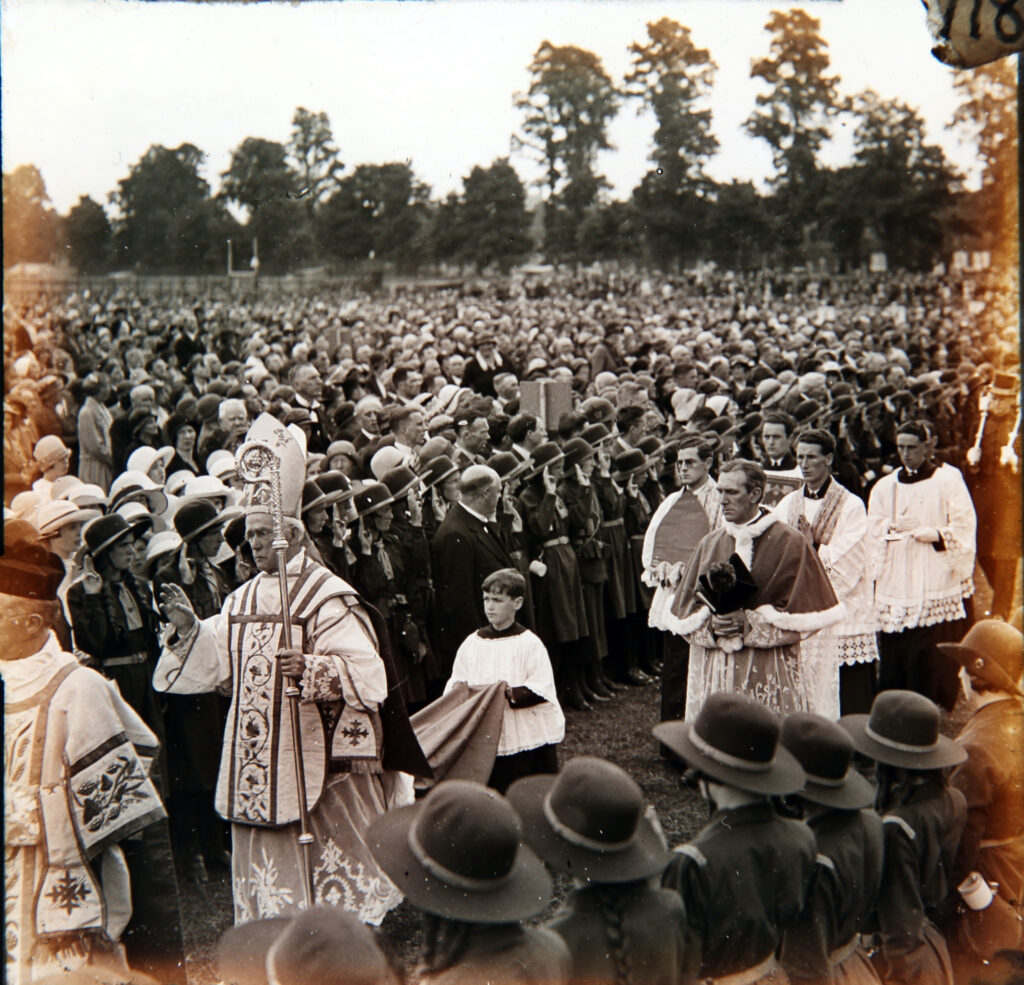
In Cork during the early years of the twentieth century the feast of Corpus Christi was normally celebrated within the confines of church buildings and adjacent grounds. At St Vincent’s in Sunday’s Well, the faithful walked in procession from the main altar to an outside courtyard and around a statue of St Vincent de Paul that stood there. The Blessed Sacrament was carried at the rear of the procession, the priest wearing a gold-embroidered cloak and walking beneath a gold-tasselled white silk ombrellino, an umbrella-shaped canopy signifying the majesty of the Eucharist and carried by a senior prefect of the confraternity. At the Capuchin friary on the Rochestown Road to the south-east of the city, the layout of the grounds meant that the annual procession could exit on to the main road via one gate and re-enter through another, with hymns and prayers recited along the way. Benediction was imparted and the ceremony finished with the singing of Faith of our Fathers. In these years celebration of Corpus Christi also took place at the African Missions College at Wilton. Here a procession made its way from the chapel along the tree-lined driveway and out on to what was at the time a country road. It then made its way back to the church via another entrance, after which benediction was imparted. These celebrations, however, paled in comparison to the city-wide Corpus Christi Eucharistic celebration that was inaugurated in 1926.
BACKGROUND
There were a number of important factors at play in the lead-up to the establishment of this event. From 1917, the organisation of the annual St Patrick’s Day parade was taken over, with episcopal approval, by the Very Revd Patrick Canon O’Leary and representatives from the different parish confraternities. From then until 1922—with the exception of 1921, when no parade took place—it became an exclusively religious occasion, culminating in the imparting of an episcopal blessing. The participants walked with the banners of their different parish confraternities and so there was a precedent in the city for this type of procession and gathering in advance of the 1926 initiative. In 1922 Bishop Daniel Coholan visited Rome and was deeply impressed by the public display of adoration of the Blessed Sacrament through the streets there, and he was well aware that the logistics of organising and holding a similar event in Cork had already been achieved. The climate of civil war, however, was not conducive to holding such an event at the time, and even after that conflict had ended, with brother having fought brother and communities divided, everyone’s priority was the creation of a settled and stable society.
As part of the emerging Irish Ireland of these years, Bishop Coholon wanted the faithful of the city to reinvigorate their spiritual lives. In February 1926 he announced that there would be a general mission in all churches throughout the city. At the end of that mission, on 14 March, a number of city bands paraded from church to church, stopping and playing hymns at each. For St Patrick’s Day the bishop ordered exposition of the Blessed Sacrament in all churches and, 1926 having been declared a Holy Year by Pope Pius XI, at the behest of the bishop different parishes undertook processions to four nominated churches to obtain indulgences. Bishop Coholan therefore wanted greater commitment to the faith as well as public manifestation of this; it is also clear that the general population bowed to his resolve. The bishop was supported in his desire by some of his close friends and confidants. Among them was Professor Charles K. Murphy of UCC, who, it was suggested, was the one who proposed the instigation of a Corpus Christi procession in 1926.
‘ALL DOWN TO PAPPIE’
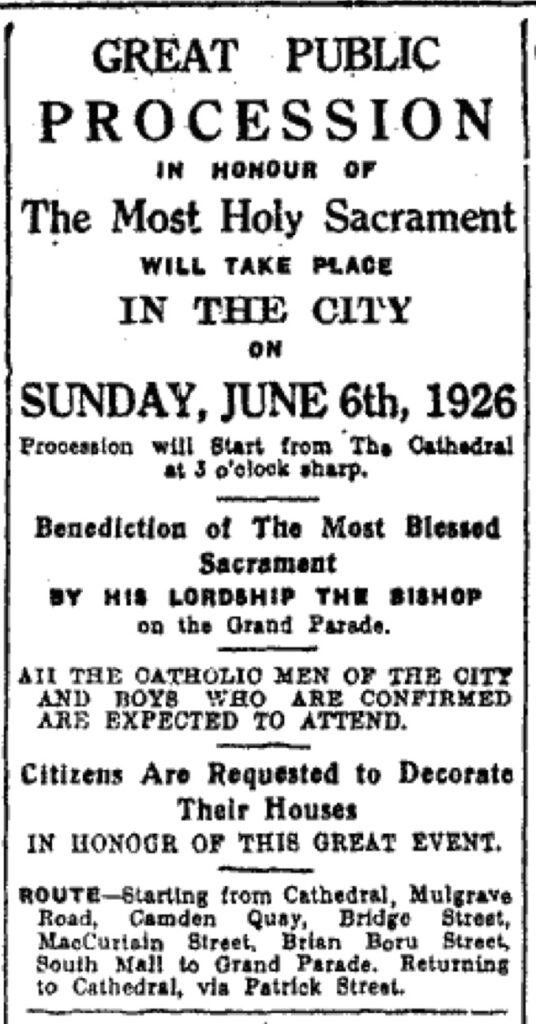
The renowned Cork musician Aloys Fleischman in his personal diary entry for Saturday 5 June 1926 wrote that ‘the procession was all down to Pappie’, referring to his father, also Aloys, who was the musical director of the North Cathedral at the time and who also had a close relationship with the bishop. The instigation of the procession, therefore, was a matter under discussion between the bishop and those close to him, resulting in an announcement in May that the upcoming feast of Corpus Christi would be celebrated in Cork in the manner seen by Daniel Coholan in Rome four years earlier. On 29 May an advertisement appeared in the press declaring that a ‘great public procession in honour of the Most Holy Sacrament will take place in the city on Sunday June 6th 1926’. The advertisement also advised that ‘all the Catholic men of the city and boys who have been confirmed are expected to attend. Citizens are requested to decorate their houses in honour of the great event.’
Over the following days more details of the arrangements were issued. Leaving the cathedral at 3pm on Sunday 6 June, the procession would take a circuitous route through the city, finishing at the altar erected for the occasion on the Grand Parade. Following benediction and the singing of Faith of our Fathers, the procession would reform and return to the cathedral via the North Main Street and Shandon Street.
OVER 35,000 PARTICIPATED
The spectacle was all that the bishop hoped it would be, ‘a striking public tribute of supreme adoration to Our Lord and Saviour in the Sacrament of the Eucharist’. The press reported that ‘the procession with all its devotion, its elaborateness and richness of its significance was indeed an epoch-making ceremonial in every respect’. Over 35,000 participated, having walked from their parishes, proudly carrying their confraternity banners, processing before the Blessed Sacrament carried by the bishop beneath an elaborately decorated canopy. Most participants also wore their sodality badges. In effect, the event unified the various separate parishes in a single public ritual, and the individual parish identities were therefore connected by the Feast of Corpus Christi in the public sphere.
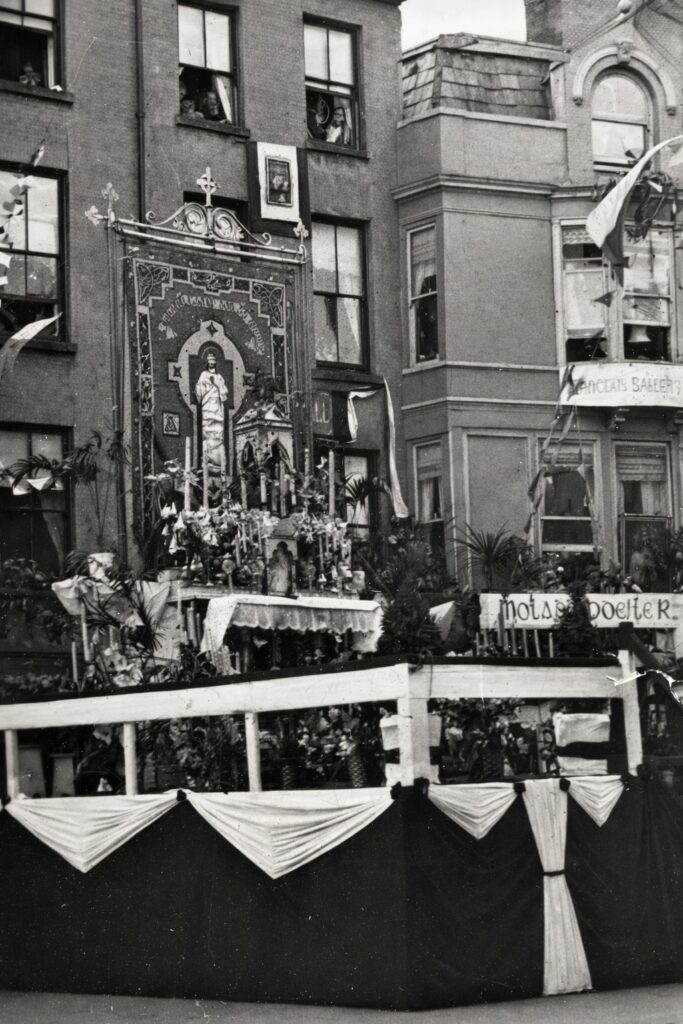
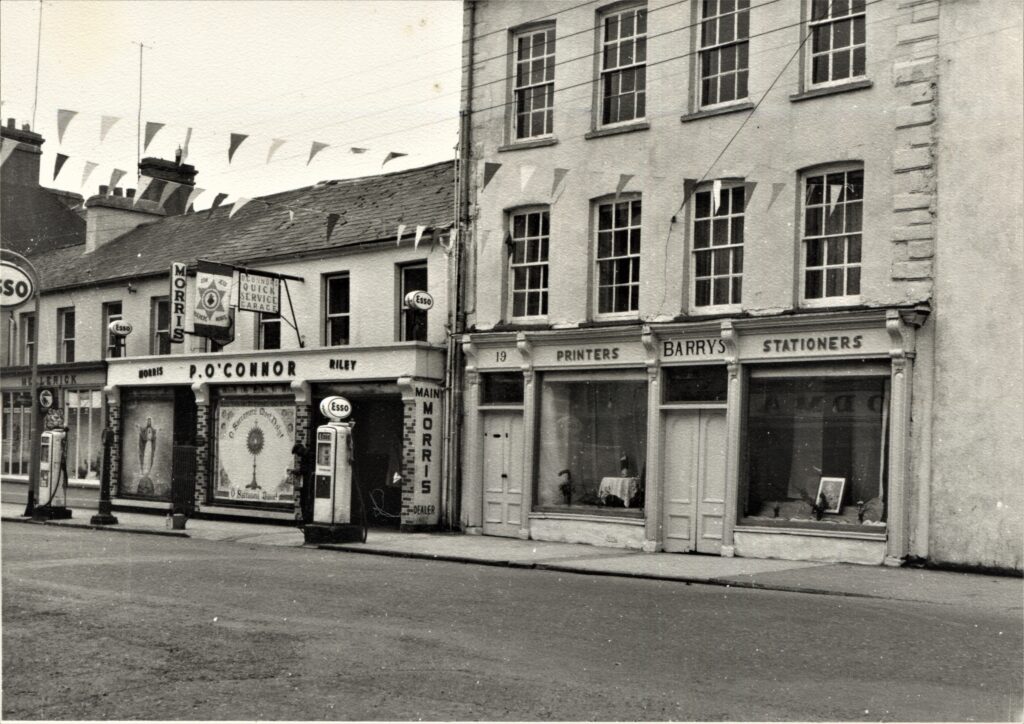
The procession took two and a half hours to pass a given point. As well as those walking, a further 35,000 watched from every available vantage point in ‘a memorable demonstration of love, loyalty and devotion to our Lord in the Blessed Sacrament and to Faith and Fatherland’. The city was transformed into an open-air place of worship and the sensory experience normally associated with church buildings helped in this transformation—the singing of hymns, the ringing of bells and at the altar the smell of incense all added to the experience. For the occasion the entire city was en fête and it was noted that it was in the poorer areas where the most elaborate decorations were put up. Many houses placed small altars in their windows, and it was noticeable too that yellow and white papal flags flew from many homes. It will have pleased Bishop Coholan well that in an editorial in the Cork Examiner on Tuesday 8 June Cork was compared with the great ceremonies in Rome. Cork on the occasion, the piece said, was a version of this.
ANNUAL EVENT
It was soon decided that the event would be held again the following year, albeit with some organisational tweaks. Now that St Patrick’s Street had been rebuilt after its destruction in the burning of Cork in December 1920, instead of going via Bridge Street, MacCurtain Street and Brian Boru Street the procession would take the shorter route across St Patrick’s Bridge and through St Patrick’s Street to the Grand Parade. In 1926 the entire event had taken almost seven hours, which was considered too long. In 1927 it was decided that the participants would walk in lines of eight, as opposed to four the previous year, thereby shortening the entire length. Also, consideration was to be given to having some bands positioned at strategic places along the route rather than walking in the procession. This would have the added advantage of assisting in the participation of onlookers through the singing of hymns. Again 35,000 participated in 1927 with over 25,000 watching, while in the following year, 1928, similar numbers participated. Interestingly, in 1928 the participants walked in rows of six because the 1927 procession had been too fast! The event was now established as Cork’s primary annual processional occasion, replacing others of former years such as the St Patrick’s Day parade. It became in fact the pinnacle of Cork’s processional culture in this period.
In 1928, under the chairmanship of Michael O’Mahony and secretary J.F. Corkery, another matter for consideration was the precise position of the altar on the Grand Parade. Many people felt that in the previous two years their view had been obscured. After discussion, however, no better position could be agreed on and so it remained as was until it was moved to Daunt Square in 1941 to facilitate the construction of bomb shelters on Grand Parade.
In the following years, two exceptions occurred to the holding of the annual Corpus Christi procession in Cork. In 1929 the event was postponed until 14 July to coincide with and be a part of the centenary celebrations of Catholic Emancipation in 1829. The second exception was in 1932, when no procession was held in the city, thousands instead making their way to Dublin to attend the open-air Mass in the Phoenix Park as part of the Eucharistic Congress held in the capital that year.
Although the Corpus Christi processional gathering was on just one day each year, when the participants returned to their parishes they embraced the monthly sodality meetings with renewed vigour. Preparations are under way to mark the centenary of the event in June 2026.
Antóin O’Callaghan was a broadcast engineer with RTÉ and has an MA in History from UCC.
Further reading
A. O’Callaghan, Processions and parades in Cork City 1898–1932 (Cork, 2020).
The Fold [Cork and Ross diocesan magazine], 1958, 1976.