
By Joseph McKenna
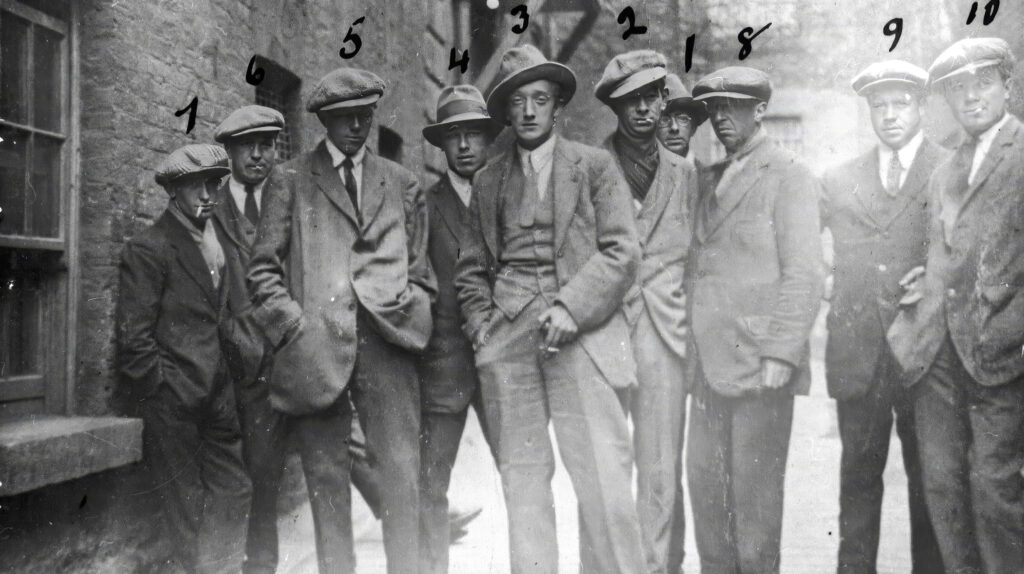
There is confusion over the Cairo Gang, the origin of the name and the men assassinated by Michael Collins’s ‘Squad’ on Bloody Sunday. We know of them today because of a photograph (above/below). The men shown are the intelligence section of F Company of the Auxiliary Division Royal Irish Constabulary (ADRIC), based in Dublin Castle during the Irish War of Independence. There are a number of copies. Probably the most informative is in the Piaras Béaslaí Collection in the National Library of Ireland. Each of the men depicted is numbered and named. Additional information was later appended:
- Dentieth, ADRIC No. 10. Wounded March 14, 1921.
- F. Fletcher, ADRIC No. 890, Irish.
- Moore, ADRIC No. 1393, Irish.
- D. Swaffer, ADRIC No. 1234.
- B. Dove, ADRIC No. 667.
- G. Appleford, ADRIC No. 589, Section Leader, shot June 24, 1921.
- F. Gorman, ADRIC No. 625.
- Winch, ADRIC No. 888. Later Intelligence Officer F. Company.
- F. McClean, ADRIC No. 588.
- A. Stapley, Military Medal, ADRIC No. 33.
The Auxiliaries adopted a no-nonsense approach, and in the process gained a bad reputation for torture and murder. Their two most feared interrogators were Captains Hardy and King. King, who commanded F Company, was a former officer in the South African infantry. He was a big man, over 6ft tall, with a reputation for brutality. Hardy, formerly of the Connaught Rangers, was a decorated but flawed war hero. Private J.P. Swindlehurst of the Lancashire Fusiliers, then based in Dublin, recalled in his diary:
‘16th January [1921] Secret Service men and detectives kept us on alert to admit them … Prisoners were brought in occasionally, a few looked about all in, covered in blood, minus teeth, and numerous other injuries. After a grilling in one of the upper rooms, we could hear groans and curses coming down the stairway, a dull thump indicated someone had taken a count, they took them off to Mountjoy Prison on the outskirts.’
F Company plain-clothes men relied largely on information supplied by touts. They were greatly hampered in their secret work by their own English accents, which gave them away as soon as they opened their mouths (hence the need for informants). Tom Cullen and Frank Thornton of IRA intelligence, through two policemen likewise working for Michael Collins, were introduced as their touts. They met at Rabbiatti’s restaurant. Thornton recalled:
‘Tom and I found ourselves with three [British agents] sitting around a table having fish and chips. A general discussion was taking place when one of these fellows, who was an English man, turned to me and said, “Gor blimey, how did you learn the Irish brogue? We’re here twelve months and we can’t pick up any of it.” Of course, naturally we told them that there was an art in these matters and just passed it over. Naturally men of this kind were of very little use, but the British didn’t realise that until it was too late.’
To IRA intelligence, led by Michael Collins, they were known as the Special Gang. The information leading to their identification was, perhaps surprisingly, supplied by a fellow Auxiliary, Major John Shaw Reynolds, through a friend of his, Brighid Foley. There is perhaps a suggestion of romance between the two but, for whatever reason, Reynolds agreed to pass on information.
So why are they better known as the Cairo Gang? The name allegedly originated in the 1950s. Two theories have been put forward. The first, that the unit was formed in Cairo in Egypt, we can discount. The second explanation is that they met on a regular basis at the Cairo Café on Grafton Street, or, more specifically, that their name is derived from the fact that two of their members were targeted for assassination near the Cairo Café on 24 June 1921. The two men were L.G. Appleford (No. 6 in the photograph), who was wounded, and George Warnes (not included in the photograph), who was killed. For want of a name for the group, the title ‘Cairo Gang’ was adopted.
Members of the Cairo Gang have been confused with the British officers who were assassinated on Bloody Sunday, 21 November 1920. Once the claim was put forward, later writers accepted it as fact, seemingly without bothering to check. One writer even tried to match up individuals in the photograph with the British Army intelligence officers assassinated on Bloody Sunday.
On 17 November Michael Collins wrote to Dick McKee, commandant of the Dublin Brigade: ‘Dick, I have established the names of the particular ones. Arrangements should be made about the matter. Lt. G. is aware of things. He suggests the 21st. A most suitable day I think. M.’ ‘Lt. G.’, or the ‘Little Gentleman’, was the alias of Lily Mernin, a shorthand typist in the British Department of Defence in Dublin Castle. The change from feminine to masculine gave her extra protection should any material be discovered by the British. In her Witness Statement she wrote:
‘Before the 21st November 1920, it was part of my normal duty to type the names and addresses of British agents who were accommodated at private addresses and living as ordinary citizens in the city. These lists were typed weekly and amended whenever an address changed. I passed them on each week either to the address at Moynihan’s, Clonliffe Rd or Piaras Béaslaí.’
These agents were members of British military intelligence, a far more dangerous organisation with experience in gathering, analysing and acting on information. Collins became convinced that he must get them before they got him. They had already killed a senior IRA man. In the early hours of 23 September 1920 John Aloysius Lynch, the local Sinn Féin overseer of the Dáil Loan, was murdered in his bed at the Exchange Hotel in Dublin. In the early hours three British officers, wearing trench coats, military caps and goggles, burst into his room and shot him. David Neligan, a policeman and agent for IRA intelligence, looked through the police station daybook and discovered that Captain Baggalley and two other men had gone to ‘arrest’ Lynch. The two others were revealed to be Henry Anglis, alias Patrick Mahon, and Charles Ratsch. Lily Mernin was told, off the record, by a fellow Dublin Castle typist, at whose house the men lodged, that Anglis, when drunk, had confessed to his part in the murder.
The day chosen for the mass assassination was ‘suitable’ in that there was to be a big Gaelic football match at Croke Park that afternoon. Dublin would be crowded for most of the day, allowing the ‘Squad’ and the active service units involved in the assassinations to lose themselves in the crowds of supporters. In all, 40 men had been selected for execution. This was whittled down by half. Not all of them were at home on the morning of the operation, and in addition there was collateral damage: Auxiliary Frank Garniss stumbled onto the scene at the sound of gunfire. A total of eleven British Army officers were killed that day: Captain W.F. Newberry, Major C.M.G. Dowling, Captain P. McCormack, Lieutenant D.L. MacLean, ADRIC cadet Frank Garniss, Lieutenant G. Bennett, ADRIC cadet C.A. Morris, Lieutenant H. Angliss, Captain L. Price, Lieutenant A. Ames and Captain G.T. Baggallay. So two of the three killers of John Lynch were themselves killed on Bloody Sunday, 21 November 1920.
This should now dispel the confusion concerning two very separate groups of intelligence-gatherers for the British
.Joseph McKenna is the author of The fight for Dublin (McFarland & Co., 2021).
Further reading
C. Dalton, Dublin’s fighting story (Cork, 2014).
P. McMahon, British spies and Irish rebels (Woodbridge, 2008).
D. Neligan, The spy in the Castle (London, 1999).
C. Woodcock, An officer’s wife in Ireland [with an introduction by Tim Pat Coogan] (Dublin, 1994).