
TG4, 4 March 2026
By Sylvie Kleinman
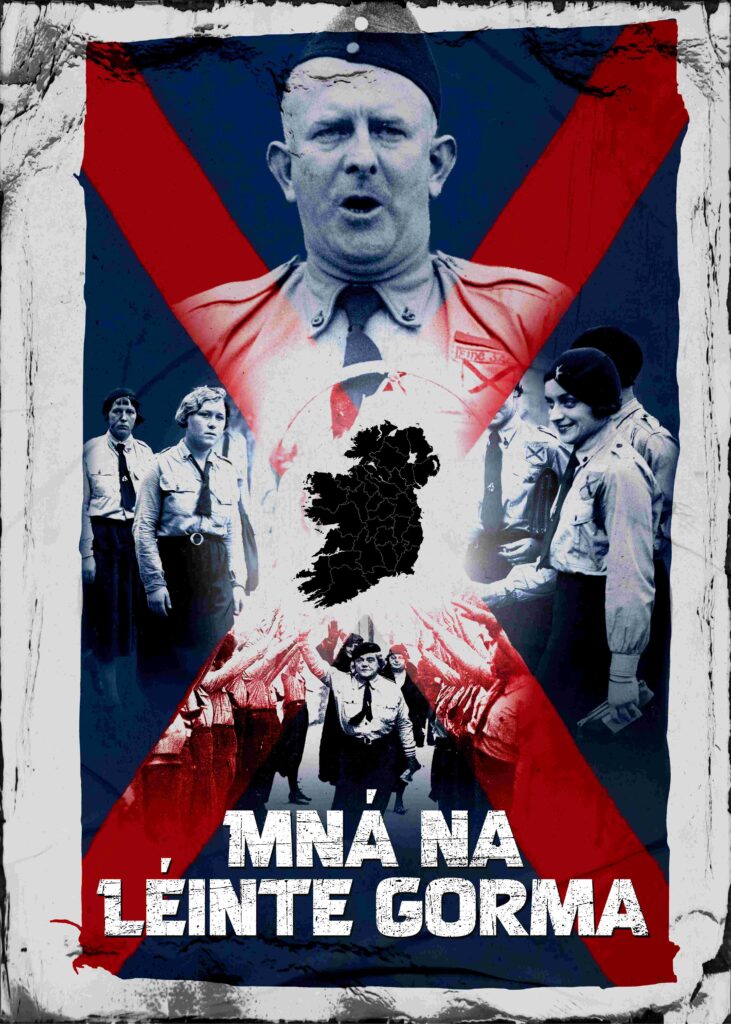
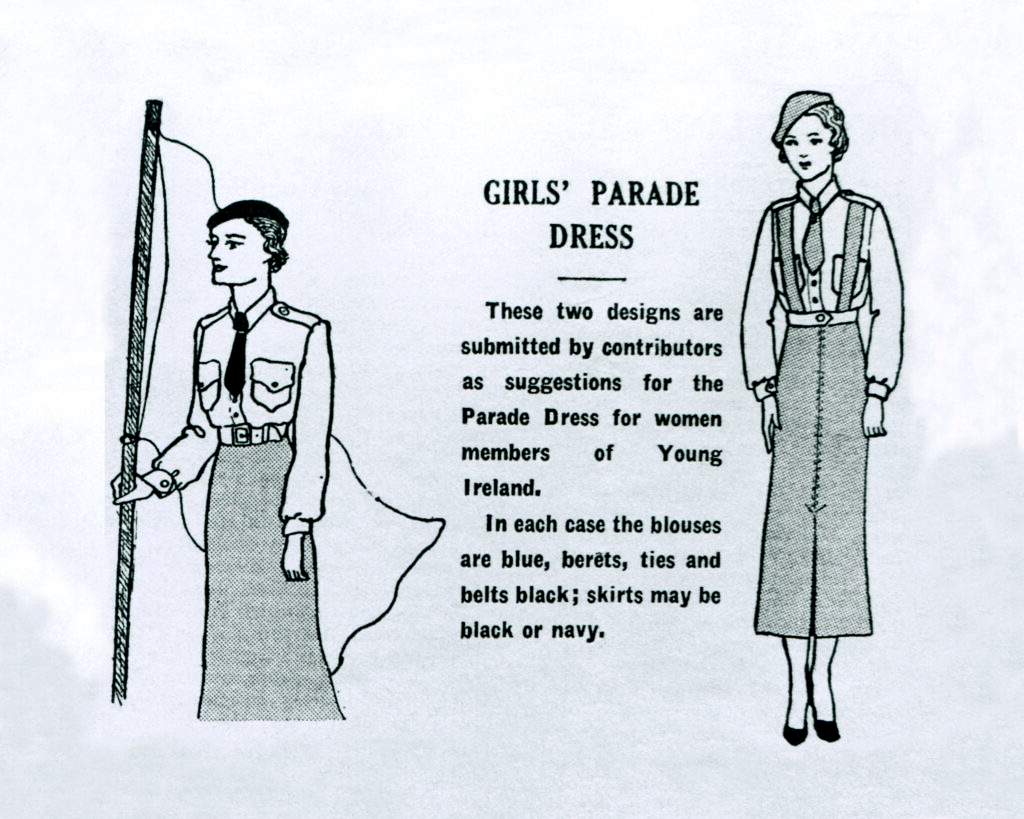
It is safe to say that until this deftly constructed documentary few of us had heard of the so-called ‘Blue Blouses’. Supporters of Cumann na nGaedheal and then Fine Gael (1933), they have remained hidden from history, and not only behind their infamous male counterparts. Their story is here presented objectively to the public, and some of the interviewees discovered relatives among them, even gleefully spotting them parading in a photo. In July 1933 Eoin O’Duffy’s fascistic National Guard, widely known as the Blueshirts owing to their militaristic uniforms and rituals, opened membership to women, who adopted and feminised their parade dress. Within a year, these ‘League of Youth’ branches in every Free State county had grown, and they outnumbered the Irish Countrywomen’s Association, Cumann na mBan and other political and feminist organisations. Until their demise in 1936, most Blouses were content to manage (quite ably) secondary but fundamental activities, closely interfacing with their communities and the public. These included local organisation, social events, fund-raising and even competing in athletics, but by participating in mass rallies or parades the Blue Blouses willingly exposed themselves to, were victims of and at times partook in politicised provocation and street violence not seen since the Civil War. Angry clashes broke out after IRA prisoners were released with Fianna Fáil’s victory in 1932, and the press even reported attempts to rip the blouses off the women (or coats, to get at the incriminating blouses). The film sharply explores the brutal dynamic of this political polarity blended with broader material concerns, and frames critical triggers of unrest and protest within the national agro-economic context affecting rural communities. Munster emerges as the epicentre.
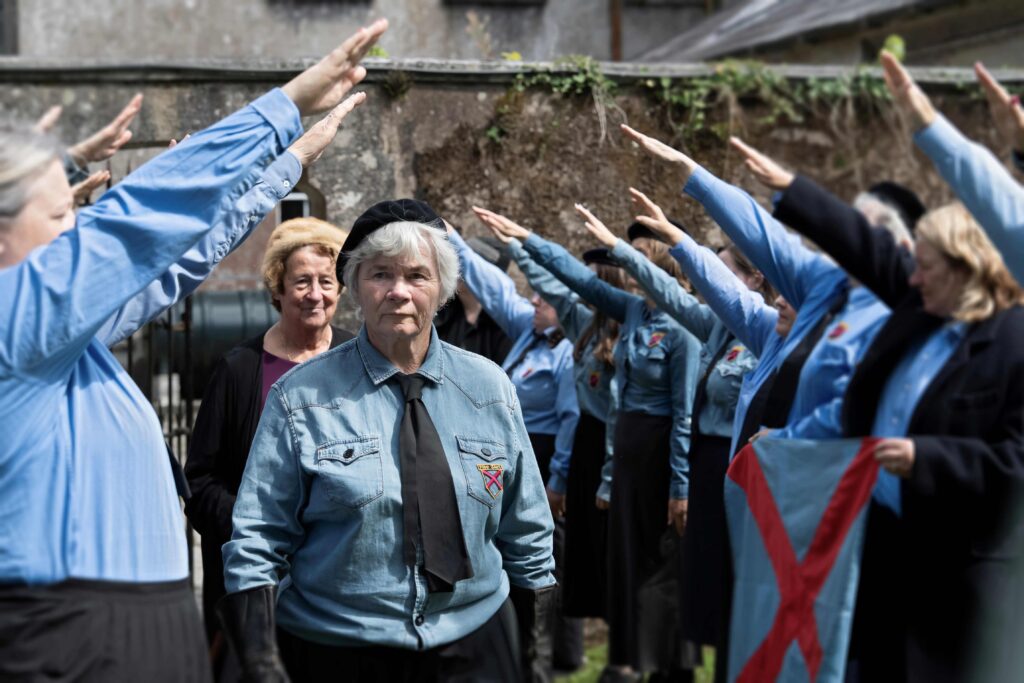
Recoil as we may from this very short-lived fascistic movement complete with straight-arm salute, until now a general lack of awareness or acknowledgement has impeded the telling of the Blouses’ story. The perception that they were on the wrong side of history is clear, but direct sources are scant. Unlike the opposite republican/feminist sphere, there are no dedicated interviews, memoirs or biographies, or they are described simply as ‘supporting the Blueshirts’. Even the two most affluent and prominent among them left no written legacies of this phase of their long and busy careers. This counter-layer of Dev’s Ireland is here compellingly recreated mostly by combing the press and scrutinising photos.
Kathleen Browne of Kilronan Castle, Wexford, was out with her local Cumann na mBan in 1919–21 and was subsequently pro-Treaty. Elected to the Seanad in 1929, she was a practising farmer and trained agriculturist and, apart from socially conservative Christian ideologies or fear of communism, was aligned with O’Duffy from that specific (and expert) perspective. Browne’s agency is aptly portrayed here and exemplifies how many from farming communities were deeply and directly affected by prevailing economic conditions. A senior regional organiser, Browne recruited both sexes; it was partially because she wore her uniform in the Seanad that it became controversial, yet it was not immediately banned for either sex, as photographs prove. Bridget Mary Redmond, from a wealthy Kildare background, was widowed only two years after marrying Willie Redmond, a Cumann na nGaedheal TD for Waterford and the only son of John Redmond. Topping the poll in the 1933 general election (at 28), her influence in that city was paired with her role as local organiser of the Blueshirts.
We are unhinged by the scene of the less nationally famous ‘General’ Mrs Mamie O’Neill taking the salute at Kinsale from female comrades, but we should consider the broader back story of Blouses photographed in the funeral procession in Cork for Michael Patrick Lynch, shot at the notorious Copley Street ‘riot’ on 13 August 1934. Daughter of a Fenian and originally Australian, O’Neill married a Cork farmer and was remembered for her grit that day. Withholding land annuity payments owed to Britain was an Irish tactic, but Dev’s government still demanded them; arrears caused cattle seizures, aggravating general hardships caused by the 1930s Economic War. On that day, Blueshirts and locals stormed an auction of seized livestock and were shot at by Broy Harriers (armed Special Branch gardaí); mayhem ensued. Trained in nursing, O’Neill had risked all to attend to the wounds of the 22-year-old Lynch, who then died.
Of what can be gleaned, many young single women joined to broaden their social contacts, perhaps make a match and access exciting experiences, all logical in remote rural communities but also demonstrating that they were engaged with politicised concerns. Many were affluent and owned a car. We also see children with berets and ties in photos but would love to know more about the pedagogical propaganda dispensed by their Blouse mothers. With knowledge now swelling, perhaps scrutiny of their United Ireland newspaper, for example, may yield more insights into the movement’s values, propaganda, symbols and rituals.
Judiciously exploiting photos as the principal source, reconstructions in this documentary were welcome, as comparisons show that they faithfully and realistically recreated photographed contemporary scenes. True to the spirit and ethics of what we may call investigative popular history, neither those interviewed nor the scripted narrative projected the slightest bias or judgement. Mná na Léinte Gorma stands out from recent big-budget documentaries, aggressively promoted because narrated by a famous thespian but also shamefully riddled with factual errors, distortions and agendas. This Bo Media production is exemplary for its straightforward storytelling, tackling an evidently uncomfortable chapter even within the families of some interviewees. Without a hint of apologetics, with focus and professionalism, it just demonstrated and analysed what happened and why, in a commitment to get it on the record. And the Blue Blouses happened in a very specific framework of prevailing social norms and ideologies fused with local and national conditions, but also during the upheaval of the first change-over of power since the birth of the Free State.
Sylvie Kleinman is Visiting Research Fellow, Department of History, Trinity College, Dublin.