
By Joseph E.A. Connell Jr
In 1921 Roddy Connolly (son of James Connolly) was the founding member and president of the first Communist Party of Ireland (CPI), which was wound up by the Communist International in January 1924 in favour of Jim Larkin’s Irish Workers’ League (IWL). Two years later the Workers’ Party of Ireland (WPI) was founded by former members of the CPI and other socialists. Among its members were Roddy Connolly, who served as party leader, Nora Connolly (daughter of James Connolly), Tom Lyng, the trade unionist P.T. Daly, Walter Carpenter Jr and Jack White. Many of its members had been active in the IWL and the party attempted to affiliate with the Communist International in place of the IWL.
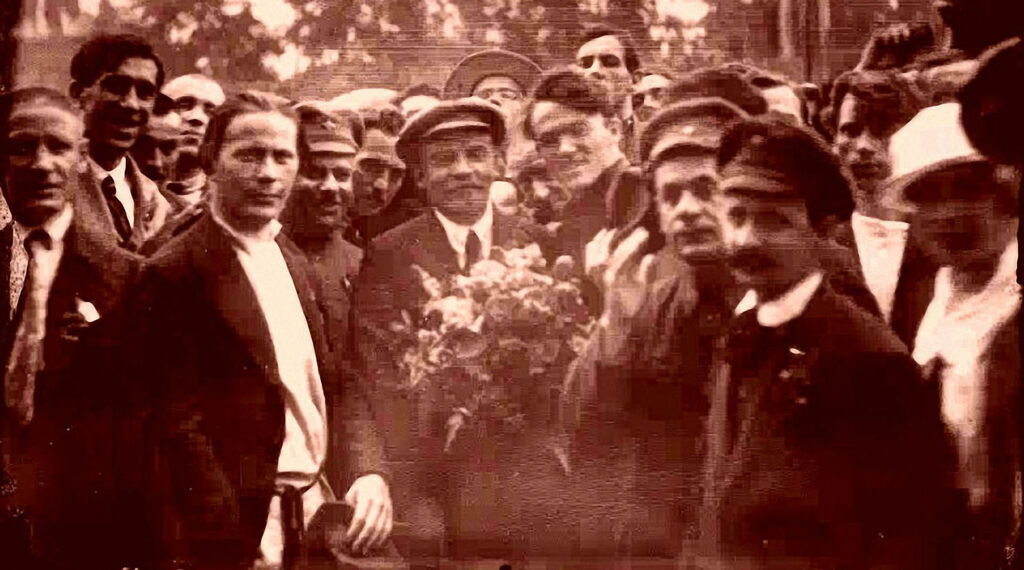
Although the lifetime of this party was brief, and Roddy Connolly’s involvement even briefer, the WPI had lasting importance. It was an attempt by Irish socialists to take advantage of what they deemed to be a political space for a radical alternative to Cumann na nGaedheal and the austere economic and political conditions over which it presided. According to the WPI, Cumann na nGaedheal was intent on maintaining the Irish Free State as an industrial British ‘outgarden’ and was unwilling to challenge the grip of British financial institutions. In addition, not only did Cumann na nGaedheal accept permanent partition in the wake of the Boundary Commission fiasco of 1925 but also the most powerful person in the cabinet, Kevin O’Higgins, had, according to the WPI, engaged in talks with the British to turn Ireland into a British Crown colony.
Owing to mounting frustration at the political inaction of Sinn Féin, left-leaning groups, guided by former members of the CPI, called a special congress in early April 1926 to form a new political party. Roddy Connolly was chosen as leader under the title of ‘education organiser’ and later ‘political secretary’, its only paid official. At a public event to mark the tenth anniversary of the execution of James Connolly on 9 May 1926, Roddy Connolly announced the existence of the WPI as a party dedicated to resolving the questions of national and social liberation raised by his father.
The WPI opposed both Éamon de Valera’s Fianna Fáil (an agent of ‘petty-bourgeois nationalism’) and W.T. Cosgrave’s Cumann na nGaedheal. However, later in the year, in line with perceptions of Soviet policy, the WPI would take a much softer line on Fianna Fáil as potential allies in the fight against British colonialism. A party newspaper, Hammer and Plough, edited by Connolly, was published from early 1926 but proved unsustainable and had folded by the following October.
Owing to mounting pressure from the Communist International to disband and accept Jim Larkin’s IWL as the primary party of Ireland, support for the WPI dwindled. Roddy Connolly resigned as leader since he did not wish to go against the wishes of the guiding movement in Moscow. Remaining members would continue to have squabbles with Jim Larkin and the IWL until dissolving the party at the end of 1927.
Joseph E.A. Connell is the author of Unfinished Republic: Éamon de Valera and his politics of negotiation, 1916–1922 (Eastwood Books, forthcoming).