
By Felix Meehan
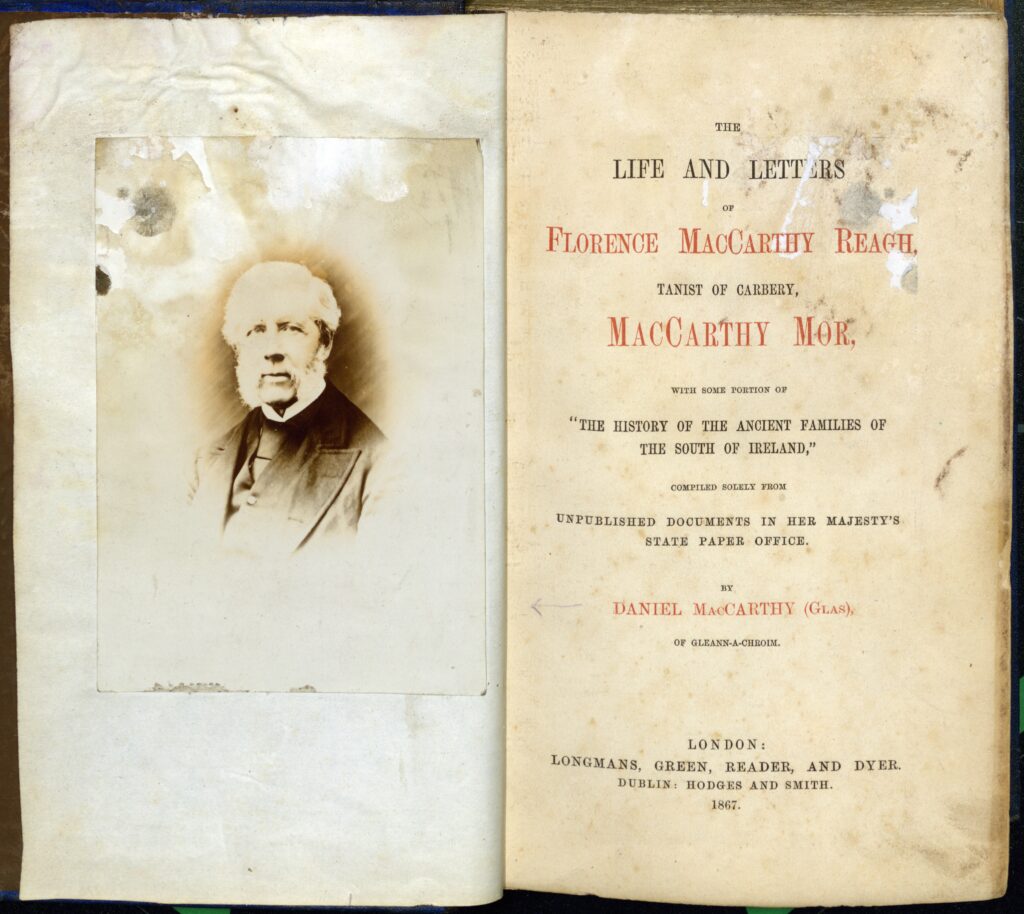
Daniel MacCarthy was born to a wealthy Catholic merchant family in London in 1807. His grandfather had emigrated from Dromdeegy near Dunmanway, Co. Cork, to London in 1763. Daniel was the author of several works of fiction, including the historical romances The siege of Florence (1840), Massaniello (1842) and The free lance (1844). He also wrote poetry and short stories. However, his great passion was the study of his MacCarthy ancestry and the history of Ireland. Most of the material in the collection relates to his research into the life of Florence (Finian, Finghín) MacCarthy Reagh, Gaelic chieftain and scholar, and the MacCarthys of Gleannacroim, Co. Cork. His books The life and letters of Florence MacCarthy Reagh (1867) and A historical pedigree of the Sliochd Feidhlimidh, the MacCarthys of Gleannacroim (1875) drew on years of research in libraries and archives, as well as correspondence with the leading scholars of Irish history and archaeology of the day.
The collection comprises almost 1,400 unique items, containing personal letters, manuscripts, photographs, paintings and drawings. As with any large personal or family archive, the scope of the collection is immense, documenting a range of topics: the lineage of the MacCarthy clan; nineteenth-century poetry and historiography; the Irish nationalist movement; the history of early modern Ireland; the French Revolution of 1848; the British Empire in India and South Africa; and the Great Famine in Ireland. Daniel’s correspondence comprises almost 1,200 items and details his deep engagement with a network of the leading Irish and British scholars, antiquarians, historians and poets of the day, including Samuel Ferguson, Richard Caulfield, Aubrey Thomas De Vere, Thomas Keightley, James Anthony Froude, Sir John Maclean and James Henthorn Todd, to name but a few.
Two of Daniel’s most regular correspondents were John O’Donovan and Denis Florence MacCarthy. O’Donovan—one of the leading Irish scholars and historians of his day—had an extensive correspondence with Daniel over many years, answering his queries and carrying out record searches in archives and libraries on his behalf. Denis Florence MacCarthy, popularly regarded as one of Ireland’s foremost poets, corresponded with Daniel constantly from 1867 to 1879. The letters offer a detailed insight into the trials and tribulations of Denis’s life and are an invaluable source on one of the leading Irish cultural figures of the nineteenth century.
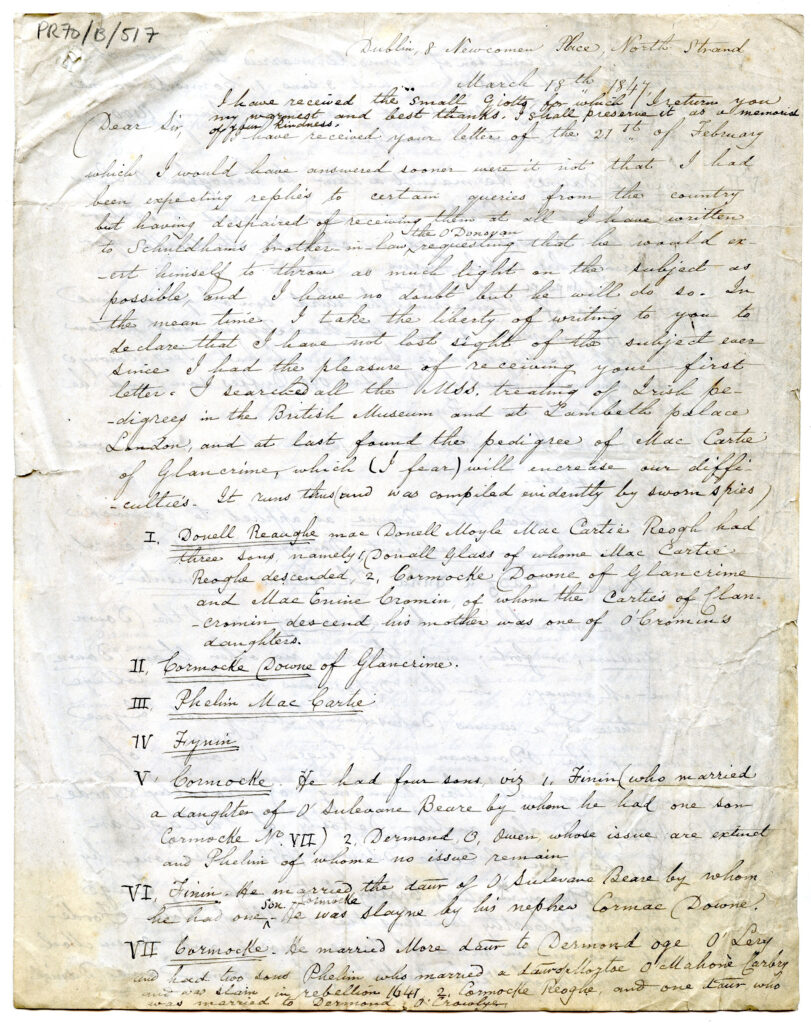
Daniel’s correspondence also includes letters from several individuals who discuss the dire impact of the Great Famine in West Cork. In one letter, written by Bartholomew Rochford of Ardcahan, near Dunmanway, Co. Cork, during ‘Black ’47’, the worst year of the Famine, Rochford reports that ‘there is scarcely a person over 50 years living at present, through the means of the pestilence, which prevailed in this country during the last season’.
One document in the archive is of immense cultural and historical significance: a 1784 family pedigree of the Gaelic prince Jeremiah MacCarthy (‘Diarmuid an Duna’) compiled by famous poet-schoolmaster Seán Ó Coileáin (John Collins) of Myross, Co. Cork. Ó Coileáin was known as the last bard of Munster, and it is said that he could recite much of the ancient history and genealogies of the region. This unique document, written in a combination of Irish and English, is one of very few original manuscripts that we know of in existence from Ó Coileáin or, indeed, any other Gaelic scholar of that period. Written on parchment, the pedigree bears a wax seal of John Butler, Catholic bishop of Cork, later Baron Dunboyne. The pedigree has been subject to a detailed process of transcription and interpretation by Dr Cornelius Buttimer, formerly of University College Cork. This pedigree helped to locate a missing link in Daniel MacCarthy’s own family pedigree and solved the mystery of who was the father of Daniel’s great-great-grandfather, Cormac Glas.
Daniel MacCarthy was a noted philanthropist and sponsored the education of students, supported poor families and individuals in West Cork, and commissioned public monuments to honour the MacCarthy clan, all of which are documented in detail in the collection.
The collection also includes a significant number of records relating to Daniel’s wife, children and grandchildren. Many of these records were created after Daniel’s death in 1884 and broaden the scope of the collection greatly in terms of geography (with records relating to India, South Africa and the USA), medium (many of the records consist of paintings, drawings and photographs) and date (with records dating up to 1940).
Susan MacCarthy-Hallett and Don MacCarthy, great-great-grandchildren of Daniel MacCarthy (Glas), found the collection in a number of tea chests when clearing out their parents’ house in Oregan, USA. Seeing the material in the collection for the very first time and noticing that a place called Dunmanway kept being mentioned in letters and documents, they made contact with historian Michelle O’Mahony, who lives in Dunmanway, Co. Cork. Michelle then contacted Cork City and County Archives, and Susan and Don kindly donated the rediscovered collection in 2016.
Felix Meehan is Archivist with Cork City and County Archives Service.