
RICHARD MAHER
Pen and Sword
£25
ISBN 9781036134099
REVIEWED BY
Stephen Griffin
Stephen Griffin formerly lectured in History at the University of Limerick and is currently employed by Limerick Civic Trust.
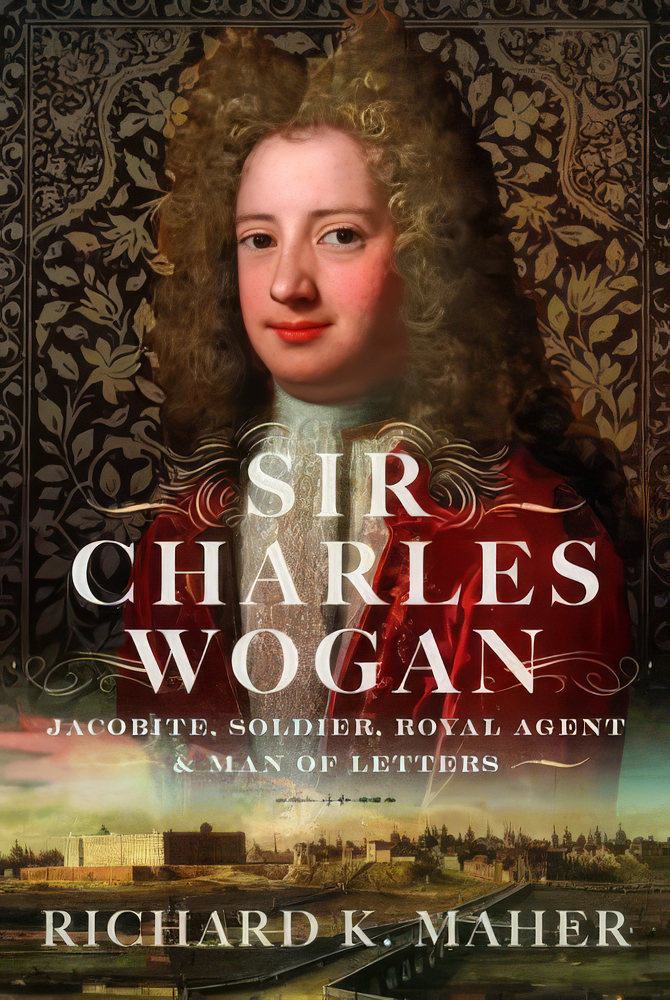
The life and activities of Sir Charles Wogan will be familiar to anyone knowledgeable on the Irish diaspora in eighteenth-century Europe. Yet for all Wogan’s colourful adventures in the 1700s, we have had only one biography of the man: J.M. Flood’s The life of Chevalier Charles Wogan: an Irish soldier of fortune (Dublin, 1922). Now, however, we have a new and updated biography by Richard Maher.
Wogan’s date of birth has long been subject to speculation but, as Maher notes, the most plausible year is 1685. The author hypothesises that Wogan joined Berwick’s Regiment in France at some point around 1706–10. While he notes that this is only a possibility, it does help explain how Wogan came to be so involved in Jacobite activities, participating in the Jacobite rising of 1715 as an aide-de-camp with the English Jacobite forces. Suffice it to say that the rising of 1715 was a failure. Wogan was captured, escaped to France and was quickly brought back into the fold of Jacobite intrigue and diplomacy, as the head of the Stuart court, James Francis Edward Stuart, sought political support for a restoration and a wife to secure the Stuart succession.
It was Wogan who identified Maria Clementina Sobieska as an ideal wife for James. The events surrounding Maria Clementina’s detention and rescue are recounted, as the princess was imprisoned by imperial authorities in Innsbruck before being whisked over the Alps to Papal Italy. Maher notes that two versions of the events were relayed by Wogan in the 1720s and 1740s, highlighting the man’s willingness to portray himself in a cunning light. Further scrutiny in this vein and an examination of how embellished or otherwise the accounts of the rescue might be would have been interesting, but Maher opts to stick to the narrative. The story itself is a good one and will hopefully pique the interest of budding historians. Following Clementina’s escape, Wogan was made a senator of Rome by the pope and a knight-baronet in the phantom Jacobite peerage. However, his conflict with James’s favourite, James Murray, led to his entering Spanish service, though he remained in contact with James in Rome.
The second half of the book examines Wogan’s life in Spain. These chapters outline his interactions with the Spanish court, the development of his family, the routineness of his military life (excepting participation in the Spanish expedition to Oran in 1732), and the financial difficulties experienced by soldiers in Spain. Maher deserves to be commended for his research in Spanish archives in these sections and they are some of the strongest in the book because of this. Wogan remained in contact with the Stuarts and still had a part to play in Jacobite activities, helping to garner Spanish support for Charles Edward Stuart and the rising in Scotland in 1745. This is an aspect of the ‘Forty-Five’ which is often overlooked and Wogan, by now a corregidor of the province of La Mancha, was instrumental in securing four ships, which the Spanish dispatched to aid the prince. Wogan himself attempted to get to Scotland to join the prince but only got as far as France by the time the rising was defeated. He returned to military life, finishing out his days as acting governor of Barcelona, where—as Maher’s research reveals—he was buried in the grounds of Barcelona Cathedral.
For all the good archival research, the book is frustrating. At times Maher does not elaborate on points that are worth further probing. For example, it would have been beneficial to dig into correspondence between London and Vienna in relation to Clementina’s detention and escape. The British envoy, François-Louis de Pesme de Saint-Saphorin, accused the dowager empress Eleanore Magdalene of complicity in the escape. His surviving correspondence in Kew would certainly shed some light on British and imperial reactions to this entire affair. We also learn very little about the Alliance of Vienna (1725–9) between Philip V and the emperor, which provides the backdrop for suggestions that Wogan undertake Jacobite diplomatic duties in 1726. This was a period of increased Jacobite diplomatic activity, as Philip, 1st Duke of Wharton, James Butler, 2nd Duke of Ormonde, and James Fitz-James Stuart, Duke of Liria and Xérica, all reportedly intrigued with the Spanish prime minister, Jan Willem Ripperda. Similarly, Wogan’s proposal for a new trade agreement between Britain and Spain and the formation of a ‘Compagnie Royale Americaine’ is briefly summarised. The recent work of Dr Harry Lewis has shown that the Caribbean afforded opportunities to members of the Jacobite diaspora to influence Spanish, French and British imperial designs in the New World. It would have been rewarding to dissect Wogan’s proposal to understand what he was attempting to achieve and to give the reader a further glimpse into his mental world.
Notwithstanding, this book is easy to read and it contains a wealth of Spanish primary sources. At the same time, it is limited in its scope and bibliography and should have attempted to push its subject further with more detailed examination and discussion. Nonetheless, this is a useful book and should succeed in achieving Maher’s goal: encouraging new scholars to research Wogan’s life and correspondence across Europe.