
925 Productions, directed by Brian Durnin
By Seán Patrick Donlan
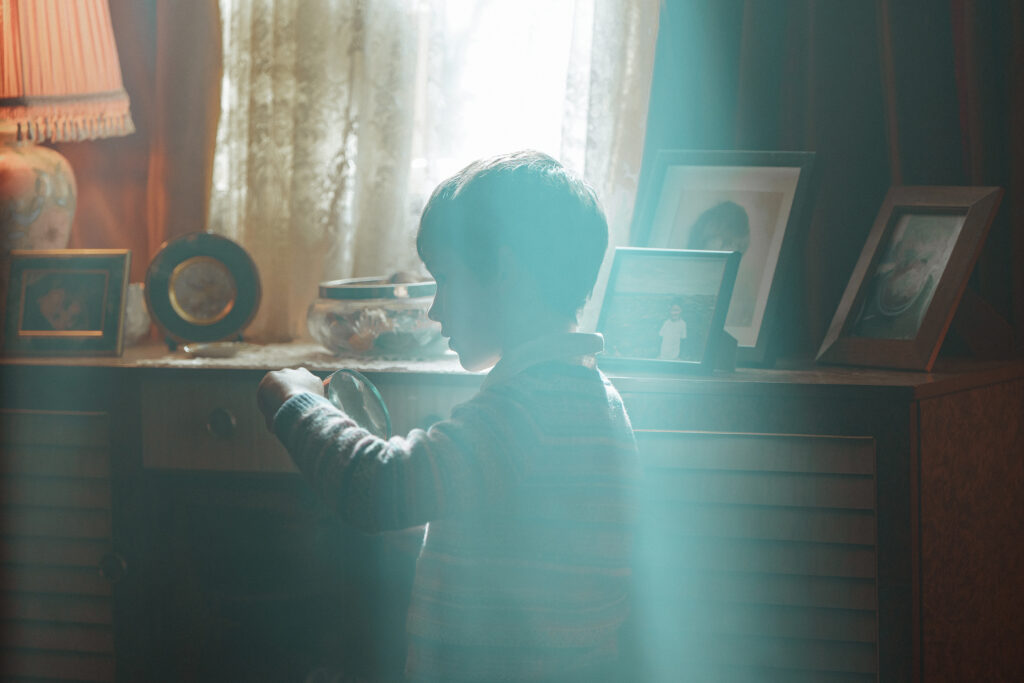
Spilt Milk arrived in cinemas in March 2026 after a long and successful festival run. It’s an accomplished film, well written and directed, wonderfully acted, and beautifully designed and shot. But like last year’s Christy (2025), it’s also evidence of fresh cinema talent and a loving look at a working-class community. Indeed, Spilt Milk is of some significance, too, to our cinematic tradition more broadly and to our perceptions of a relatively recent past.
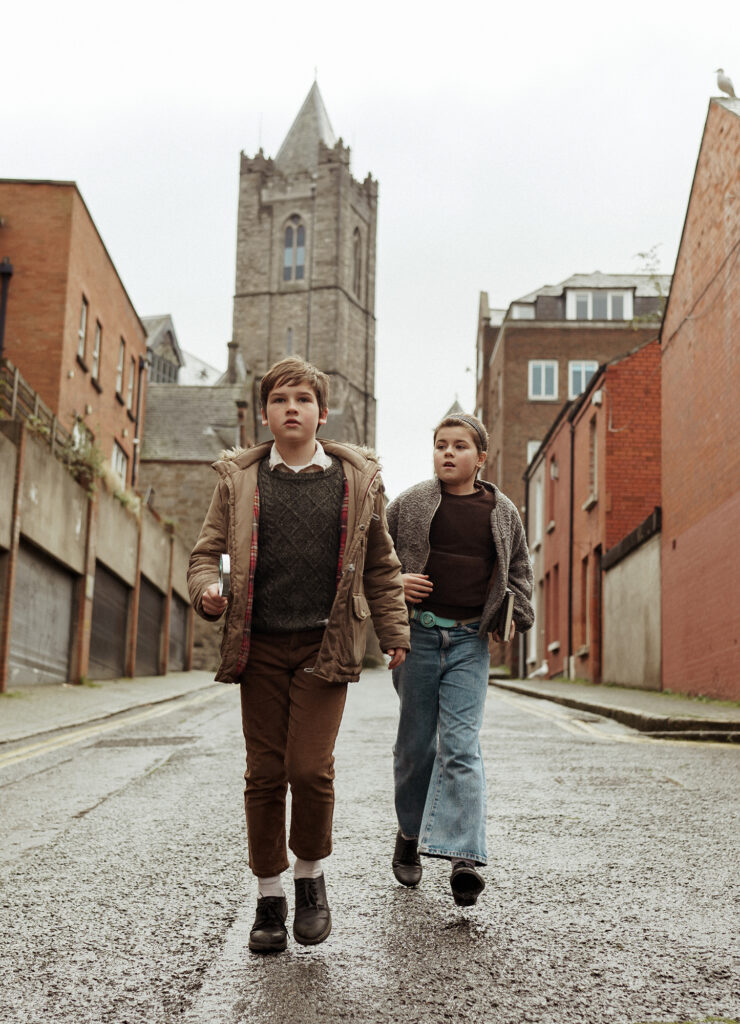
Much of the film’s press has focused on its young leads. Cillian Sullivan and Naoise Kelly are impressive as tweens Bobby O’Brien and Nell Casey. Spilt Milk is set in 1984 and the friends emulate television’s Kojak, setting out to solve petty crimes around the estate. But the film is richer, more realistic and darker than this simplistic synopsis suggests, slowly revealing an adult world often concealed from children, and a past possibly forgotten by us.
State and society experienced serious challenges in the early 1980s—unemployment and emigration, Marian apparitions and constitutional amendments, political instability and a drug epidemic. Cinema about the period was largely created after it, given the state of the indigenous film industry at the time. Especially over the last decade, films portraying the 1980s have become almost annual alongside the boom in Irish film production (see my ‘Quiet People? Ireland’s early eighties on screen’ in HI 33.6, Nov./Dec. 2025, pp 48–51).
The 1980s often saw Ireland as a film setting for stories written or produced outside the island, but there were also important artistic changes afoot. In the late 1970s and early 1980s the ‘first wave’ of Irish film-makers, especially Bob Quinn and Joe Comerford, had sought to tell more honest and probing local stories on film. Among these was Cathal Black’s Pigs (1984), which, with other films of the first wave, foregrounded individuals marginalised at the time but for whom a Dublin squat was ‘home, sweet home’.
Less well known are the films of Joe Lee and the late Frank Deasy. One Day Time (1982) and Sometime City (1985) record a Dublin on the dole and reveal a well-intended but ill-equipped state, poorly prepared for the widening drug problem. A similar account comes from contemporary documentaries. Last year the Irish Film Institute released a curated selection of Ballymun Community Films (1972–2016), including Two of a Kind and Places We Live, each from 1984 (see IFI Film Eye, HI 33.6, Nov./Dec. 2025, p. 43). Echoing and overlapping with the work of Lee and Deasy, the two documentaries underscore the failures of the state and the importance of community action for positive change.
Films since the 1980s have continued to look back at the period, often in anger. Margo Harkin’s seminal Rock-a-Bye Baby (1990) is set in 1984, and over the last decade other films have followed: Sing Street (2016), Out of Innocence (2019), Dannyboy (2020), An Cailín Ciuín/The Quiet Girl (2022), Ann (2022), That They May Face the Rising Sun (2023) and Small Things Like These (2024). Each is a unique artistic, if collective, creation rather than mere collective memory. Taken together, however, they provide important images of the period through the lens of the present.
Despite these titles, Dublin’s working-class communities have arguably been poorly served for decades. The small screen has seen several fine accounts, including Roddy Doyle’s Family (1994), Lenny Abrahamson’s Prosperity (2007) and Stuart Carolan’s Love/Hate (2010–14). But the big screen has been more disappointing. For example, Doyle’s Barrytown trilogy—The Commitments (1991), The Snapper (1993) and The Van (1996)—is entertaining but provides portraits more comic than credible. Worse, the last decade has seen a rash of low-budget movies that paint a picture of urban life less realistic than derivative, more criminal than common.
In adding another perspective on the early 1980s, Spilt Milk does much to make amends for these deficiencies. It tends to the real challenges faced by working-class communities and pays respect to their efforts to find a collective response. Set in the same year as Pigs and Hush-a-Bye Baby, Spilt Milk’s spotlight on an inner-city estate, its widening heroin problem, and state inaction and inefficacy most closely resembles the work of Lee and Deasy and the Ballymun documentaries.
The film is Brian Durnin’s feature directorial début. His touch is delicate and sure, not least in man-managing his cast. Cara Loftus’s solid screenplay was the product of a Screen Ireland New Writers scheme. Spilt Milk’s central story mirrors Dublin’s anti-drug movement of the 1980s, when groups like Concerned Parents Against Drugs (CPAD) arose from frustration with both pushers and the state. Together, Durnin and Loftus establish a nuanced image of a living, loving people, not least its strong women, anxious to get ‘pushers out’.
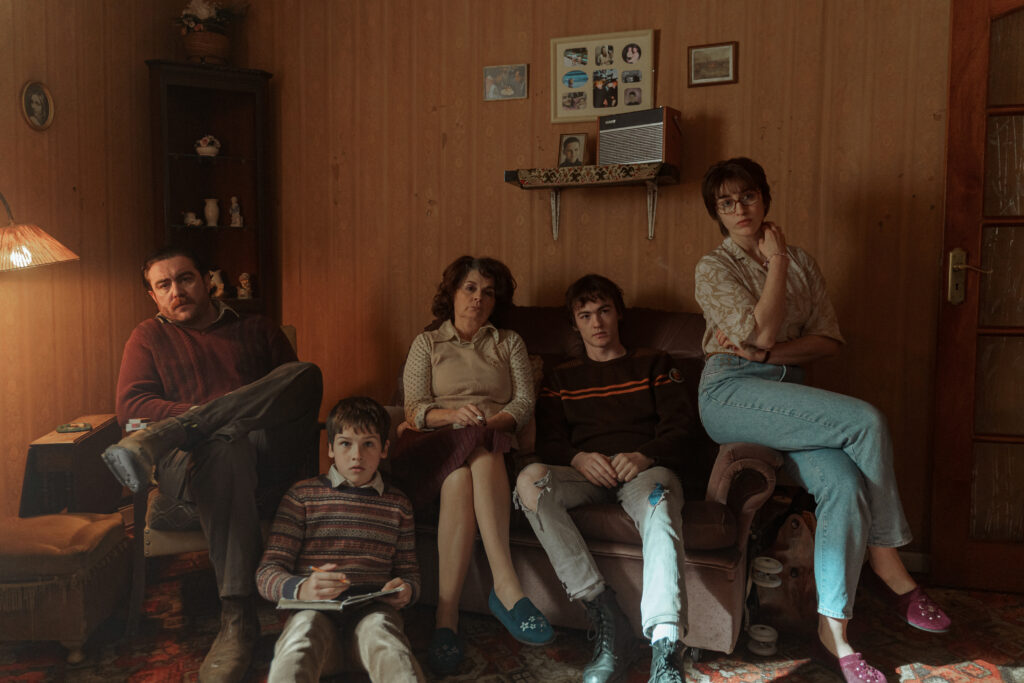
The film’s cast is uniformly sound, too. In her ‘mum jeans’ and thick glasses, Danielle Galligan excels as Bobby’s mother. She moves from the margins of the story to its centre before the film’s end. Her stock has risen considerably since Spilt Milk was shot, in the wildly unhistorical House of Guinness (see Seen on TV, HI 34.1, Jan./Feb. 2026, pp 52–3). Laurence O’Fuarian, Pom Boyd and Lewis Brophy—as Bobby’s father, Nan and brother respectively—manage, with the help of the script, to avoid tired stereotypes. Each breathes life into the complex, imperfect lives of the O’Briens.
Spilt Milk is blessed, too, with grounded and gorgeous production design and cinematography. For the latter, Cathal Watters uses his considerable experience to highlight the cracks of the estate and the light that gets in. In addition to Peaky Blinders (2013–22), Watters worked on Paddy Breathnach’s social-realist Rosie (2018). He also directed Muide Éire (2011). Written by Ruth Lysaght, that documentary is an essential exploration of the representation of the Irish on film.
Early in Spilt Milk, Bobby is pressed to recite Seamus Heaney’s ‘Blackberry Picking’ (1966). Like that poem, the film is firmly rooted in naturalism but conjures a memory of things past: vivid, sweet and bitter. It artfully conveys the childish hope that things would keep and the emerging understanding that they would not. If the film’s resolution is perhaps neater than it was in reality, Spilt Milk might nevertheless produce a few tears.
Seán Patrick Donlan is a Professor of Law at Thompson Rivers University.