
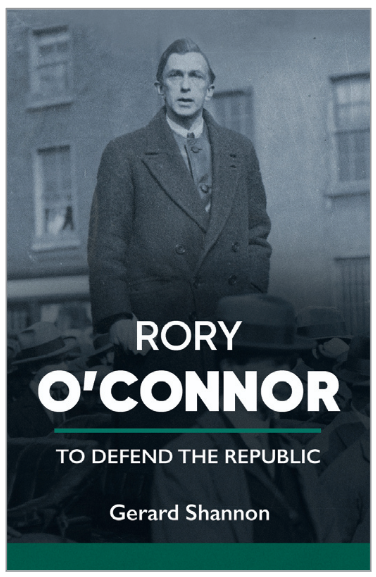
GERARD SHANNON
Irish Academic Press
€19.99
ISBN 9781785375842
REVIEWED BY
Colum Kenny
Colum Kenny is professor emeritus, DCU, and author of Myths and lies of ‘the Irish Revolution’ (Eastwood, 2025).
This is a satisfying read, not least because of its measured prose and sense of fairness. It was never going to be easy to strike the right balance when writing about a man whose actions and death in the end reflected poorly on both sides in the Civil War.
Rory O’Connor was eminently middle-class, his father a solicitor and his birth family housed comfortably in Dublin. Qualified as an engineer, young Rory left for Canada to supervise the construction of railways. He returned to Dublin intending to enlist in the British Army in the First World War. Gerard Shannon has previously written a life of Liam Lynch, the anti-Treaty IRA chief of staff who, like O’Connor, was also killed during the Civil War. What drove such men to extremes of resistance is intriguing both psychologically and politically. Shannon’s task was not made easier by the absence of a substantive O’Connor archive or by O’Connor’s ‘lack of obvious charisma’, as Shannon puts it.
A lesser biographer would have produced a hagiography of O’Connor but Shannon is calmer. Empathetic rather than sympathetic, he paints a picture of one of the leading figures of the War of Independence that is humane and respectful but not fawning. O’Connor’s sense of duty to the ideal of a republic clashed with the reality of politics as the art of the possible. Neither side in the Irish Civil War had a monopoly of patriotism or republicanism, but when a minority set itself relentlessly against an elected majority there could be only one outcome—violence.
British imperialism had taught the Irish that might was right. London’s savage threat of terrible war to repress Ireland’s democratic will in 1921 and its bloody-minded insistence on a form of loyalist oath that dishonoured Irish republicans were provocations. The cliché that the Civil War ‘started with the shelling of the Four Courts’ has been questioned by too few historians. It ignores months of prior attacks and shootings, and discounts public declarations of unbending antipathy to the Provisional Government by O’Connor and others.
As a leader (if not the leader) of the armed occupation of the Four Courts in 1922, O’Connor gave the government of the new state one choice: surrender or be destroyed. By the time that Provisional Government forces intercepted a letter from de Valera written on 13 September 1922, in which he regretfully referred to ‘Rory O’Connor’s unfortunate repudiation of the Dáil, which I was so foolish as to defend …’, both Griffith and Collins were dead and O’Connor was in jail. The subsequent removal of O’Connor and three other anti-Treaty IRA men from their cells at Mountjoy for summary execution by the Provisional Government (as a reprisal for the murder of Seán Hales TD by anti-Treaty forces) shocked people. Already in jail, none of the four could have had a direct hand in that killing. No pretence of judicial process was attempted even to suggest that they somehow ordered it.
O’Connor had been best man at the wedding of Kevin O’Higgins, a Provisional Government minister in 1922. As Shannon notes, O’Higgins broke down in tears in the Dáil when facing claims that the summary executions were just hot-blooded revenge: ‘Personal spite, great heavens! Vindictiveness! One of these men was a friend of mine.’ O’Higgins explained the killings as a practical act, done ‘coldly’ and ‘deliberately’ to deter further attacks that might smash democratic institutions. His own father would be shot dead months later, but no further assassinations of TDs occurred during the Civil War. Thus, in a sense, the government’s extra-judicial action was horribly vindicated.
Shannon negotiates O’Connor’s death deftly, neither justifying what was done nor grandstanding in disregard of the conditions in which the new state found itself. With refreshing modesty, he admits to being unable to explain adequately O’Connor’s ‘sudden wholehearted embrace of militant republicanism’ by 1916 but does offer clues (cherchez la femme).
This biography is a straight chronological narrative. It includes interesting photographs and is carefully referenced to original sources. Not for Shannon a simple reliance on unreliable works or on secondary sources that are themselves poorly referenced.
Eyebrows may rise as the author suggests in his prologue that the notion of imposing a military dictatorship on the Irish populace ‘was never seriously considered or attempted by the anti-Treaty IRA’. If this looks like a shade of whitewash, it is untypical of the book’s hue in general. The author himself describes O’Connor’s suggestion of just such a possibility as ‘ill-conceived’. One recalls de Valera’s infamous pronouncement in 1922 that ‘The people had never a right to do wrong’. Had the anti-Treaty IRA won, what else but a military dictatorship was likely? Their protests during the first six months of 1922 that they did not wish to ‘start’ a civil war were disingenuous when they were already active and only willing to stop if they got their way.
Rory O’Connor emerged from relative obscurity when he seized the Four Courts. That occupation was seared into public consciousness by the visual shock of tremendous explosions and fires that destroyed rare Irish archives in the Public Record Office. O’Connor more than anyone (given his expertise as the IRA’s Director of Engineering) was in a position to anticipate such an outcome but did too little to avoid it. Since O’Connor’s death in 1922 his reputation has not so much risen or fallen as simply receded. Gerard Shannon has now drawn O’Connor from the shadows, and his book is to be welcomed.