By Patrick Wadden
Ian Stewart’s magnificent recent book, The Celts: a modern history, and Mark Williams’s perceptive review (HI 33.6, Nov./Dec. 2025) have brought questions about Ireland’s Celtic identity back into focus. The tendency to label as ‘Celtic’ everything associated with early Ireland—and assorted modern phenomena that wish to associate themselves with Ireland’s distant past (Celtic yoga, anyone?)—shows no sign of abating. This is in spite of the fact that there has been considerable debate among scholars about the appropriateness of the ‘C-word’ as a label, particularly outside a linguistic context. One of the key issues in this debate is that, while the term ‘Celt’ itself has ancient roots, its application to Ireland and to the Irish (as well as to the Welsh, Scots and Bretons) is an entirely modern phenomenon. Nobody called the Irish language, culture or people ‘Celtic’ until the eighteenth century. Stewart’s achievement, as Williams noted, has been to illuminate the emergence of the term and its rise to popularity in the modern period, and to elucidate the intellectual and broader cultural currents and contexts within which it gained widespread acceptance.
One aspect of these developments that has attracted less attention to date is the adoption of the Celtic label in Irish. As we shall see below, the first author writing in Irish to describe his own language as ‘Celtic’ was Tadhg Ó Neachtain, a teacher and scholar who lived in Dublin in the eighteenth century. As the first Gaeilgeoir to identify as the speaker of a Celtic language, the case could be made that Ó Neachtain was the first Irish Celt.
THE GAELS, THE PEOPLE OF EARLY MEDIEVAL IRELAND
As Stewart reminds us, the inhabitants of early Ireland called themselves Gaels (Old Irish Goídil) and their language Gaelic (Old Irish Goídelc). They had no conception that their language was related to Welsh, Breton or Gaulish, and no sense of affinity with other Celtic-speaking peoples. The exceptionally rich medieval literature for which Ireland is famed, including the stories of Cú Chulainn and Fionn mac Cumhaill, has much to tell us about the cultural identity of the Gaels. Nowhere in this material are the words ‘Celt’ or ‘Celtic’ to be found.
Rather than as Celts, medieval Gaels thought of themselves as related to the Scythians (people who lived to the north of the Black Sea in ancient times) and the Egyptians. Their historical traditions, encapsulated in Lebor Gabála Érenn (‘Book of the Taking of Ireland’, sometimes called the ‘Book of Invasions’), assert that the Gaels were descended from a Scythian nobleman who married the daughter of the Egyptian pharaoh. Their son, Gael, was believed to be the common ancestor of all the Irish, to whom he gave their name. The origin-legend contained in Lebor Gabála remained central to concepts of Irish history and identity throughout the medieval period and beyond. Geoffrey Keating, for example, writing in the 1630s, drew heavily on it for his Foras feasa ar Éirinn (‘History of Ireland’), repeating the claim that the Irish were of Scythian origin.
TADHG Ó NEACHTAIN
Tadhg Ó Neachtain (d. c. 1752) and his father, Seán (d. 1729), were at the centre of a circle of Irish-language scholars in eighteenth-century Dublin. Tadhg lived and operated a school on South Earl Street in the Liberties. He wrote in Irish but also had a command of English and Latin. His intellectual interests were broad, spanning history, geography and religion, and his surviving writings include both transcriptions of older material from medieval Irish manuscripts and his own compositions.
In the late 1720s, Ó Neachtain wrote a geographical treatise called Eólas ar an domhan (‘Knowledge of the world’). In one section of this fascinating text, he makes the case that the Gaels were the oldest—and thus, in the thinking of the time, the most respectable—nation in Europe. In support of this claim, he cites ‘the polyglot Mac Líath’, who had compared Irish with the ancient languages of the world while compiling a dictionary in London in 1707. To this Mac Líath is ascribed the belief ‘that the Irish language was as old, or even older than Greek, since the Gaels who developed the language came from Scythia and Scythian Celtic is older than Greek, as all the world acknowledges’. Ó Neachtain also claimed to have tested the theory that Irish was related to Celtic by comparing versions of the Lord’s Prayer in both languages, concluding that ‘there is little distinction between them’.
Ó Neachtain’s association of the Irish language with Scythian was likely influenced by his knowledge of Lebor Gabála. At one stage in his career, he had transcribed a version of this text from the fourteenth-century manuscript known as the Book of Ballymote. As noted above, this origin-legend traces the Gaels to a Scythian ancestor, but neither Lebor Gabála nor any other text in the Book of Ballymote identifies the Irish language as Celtic.
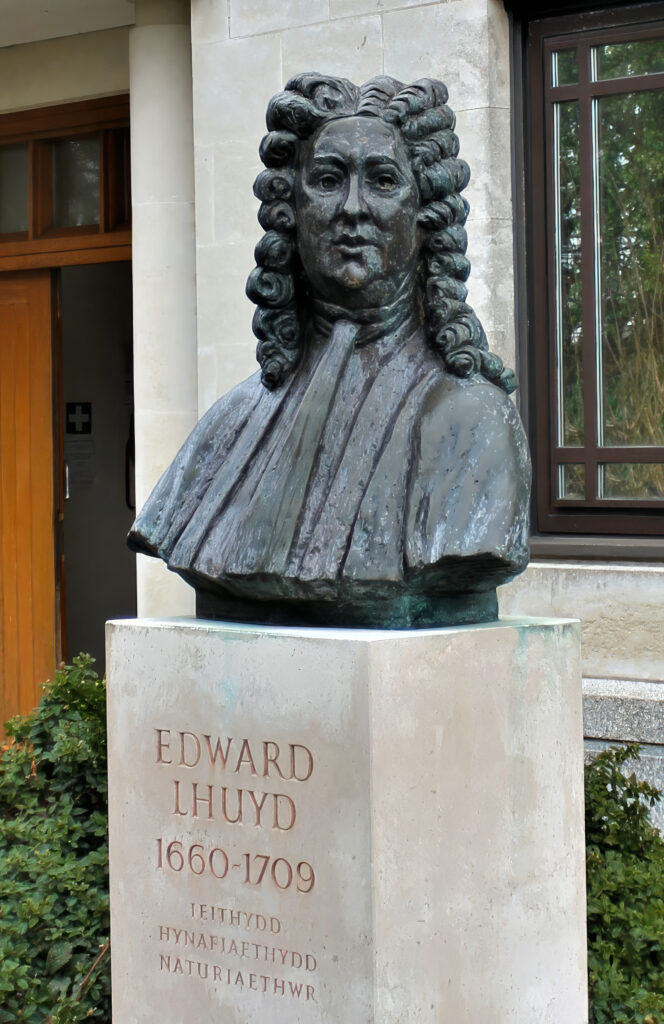
EDWARD LHUYD
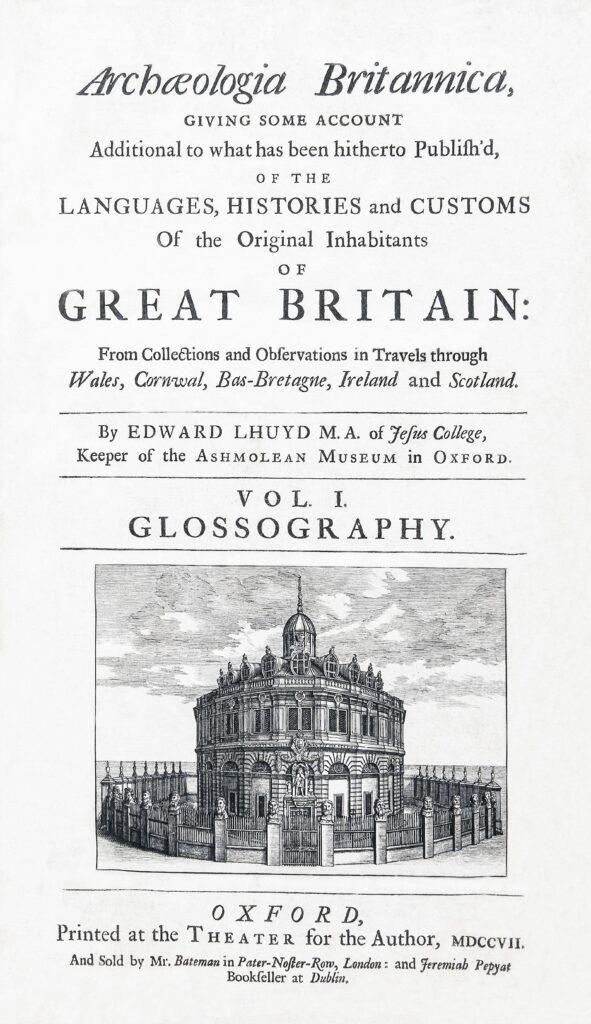
In fact, Ó Neachtain got the idea that Irish was a Celtic language from a source written much later, during his own lifetime. Hiding behind the Gaelicised surname ‘Mac Líath’ we find Edward Lhuyd (d. 1709), the great Welsh polymath and keeper of the Ashmolean Museum in Oxford. Among his many achievements, Lhuyd is most famous for his ground-breaking work as a linguist. His Archaeologia Britannica, which he described as ‘a sort of Latin–Celtic dictionary’, was published in London in 1707, as Ó Neachtain noted. A comparative linguistic study of Welsh, Cornish, Breton, Irish and Scots Gaelic, the book demonstrated that these languages were all related and used the term ‘Celtic’ to refer to them as a group. Lhuyd was not the first to note the similarities between some of these languages; the Breton monk Paul-Yves Pezron had laid the groundwork with regard to Welsh and Breton in 1703, but Lhuyd expanded on Pezron’s work by demonstrating that Irish also belonged to this Celtic family of languages. The strength of Lhuyd’s scholarship lent this argument credence and popularised the use of Celtic terminology among later scholars.
ANTHONY RAYMOND
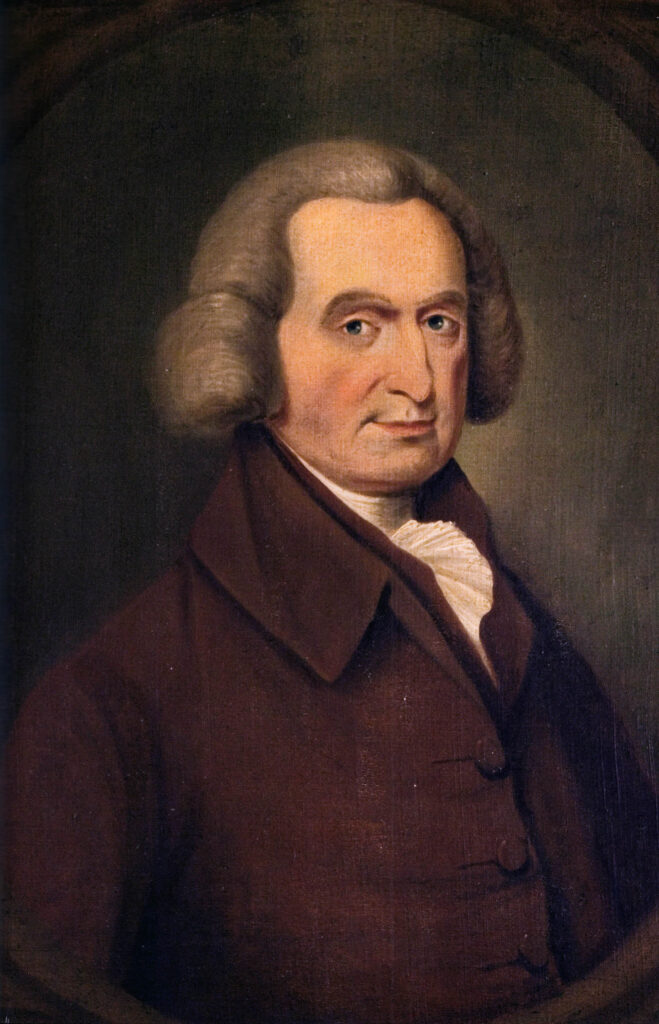
Ó Neachtain may have read Lhuyd’s work himself, but his knowledge of it was more likely mediated through the writings of his patron, Anthony Raymond (d. 1726). Raymond was a Church of Ireland vicar, a fellow of Trinity College and a friend of Jonathan Swift. Although he wrote in English, he had a strong grasp of Irish and a deep interest in the language. Ó Neachtain referred to him as athbheothaí na Gaeilge (‘the reviver of Irish’). The two men were friends; it was Raymond who had borrowed the Book of Ballymote from Trinity College for Ó Neachtain to transcribe, and Ó Neachtain later composed a poem in Raymond’s honour.
Raymond published his Preliminary discourse to the history of Ireland in London in 1725. He had read both Lhuyd and Pezron and, having compared Irish with the Celtic vocabularies in their works, ‘found almost an universal Agreement amongst them’. To demonstrate this fact, Raymond included in his book two copies of the Lord’s Prayer, the first labelled Waldensis seu Celtica, ‘Waldensian or Celtic’, and the second Hibernica, ‘Irish’. The similarity of the language in the poems confirmed, in Raymond’s estimation, that Irish was a Celtic tongue.
As an aside, it is worth noting that Raymond’s source for the ‘Celtic’ text of the Lord’s Prayer was likely a volume called Oratio Dominica, published in London in 1700, in which the ‘Our Father’ was printed in more than a hundred different languages and dialects. Here the version labelled Waldensis is sandwiched between the Cornish and the Old English. The fact that it is so similar to Irish is explicable on the basis that it is mislabelled: what is presented as ‘Waldensian’ (a Romance dialect related to Occitan and spoken around the border of Italy and France) is in fact Scots Gaelic! Irish and Scots Gaelic are much more closely related to each other than either is to Welsh, for example, since both are derived from the language spoken in Ireland and parts of northern Britain in the early Middle Ages, known as Old Irish.
Raymond was familiar with Irish historical traditions regarding the Scythian origins of the Gaels. This is why he was so attracted to the term Scythoceltae used by the ancient Greek geographer Strabo. Strabo’s label allowed Raymond to identify the language of the Scythians as Celtic. This squared the traditional view of the Irish as descended from the Scythians with the emerging theory that Irish was a Celtic language.
It was through his familiarity with Raymond’s work that Ó Neachtain also identified the Irish language as Celtic. Raymond and Ó Neachtain were not alone. John Toland (d. 1722) was born into a Catholic, Irish-speaking family in Derry in c. 1670. He converted to Protestantism in his teens and was best known for his polemical religious writing. Toland apparently developed his ideas regarding the Celtic identity of the Irish language as early as the 1690s—he claimed credit for convincing Lhuyd of the point—but his work on the topic only appeared in print in the 1740s. Within a decade, the influential antiquary Charles O’Conor of Belanagare (d. 1791)—one of the leading Catholic cultural figures in eighteenth-century Ireland—wrote in his Dissertations on the ancient history of Ireland (1753) that the Gaels were ‘descended from the most humane and knowing Nation of all the old Celts’. The die was cast, and the Gaelic Irish have been Celts ever since.
EUROPEAN CELTS
As we have seen, Ó Neachtain shared with Raymond a sincere interest in Ireland’s medieval literary heritage and in the fate of the Irish language. But these men were not conservative antiquaries. It is a mischaracterisation of Gaelic scholars in all eras, from the medieval to the modern, to suggest that they were backward-looking and detached from broader cultural currents of their own times. This was never the case, and certainly not in eighteenth-century Dublin. Raymond and Ó Neachtain were as interested in contemporary events and intellectual developments on the international scene as they were in Ireland’s past. It was this engagement with the wider world of European learning that led these Irish scholars to label their language as Celtic.
Patrick Wadden is Assistant Professor of Medieval History in the School of History and Geography at Dublin City University. He is the co-editor, with Brendan Kane, of An Eoraip: Gaelic Ireland in medieval and early modern Europe (Leiden, 2025).
Further reading
A. Harrison, Ag cruinniú meala: Anthony Raymond (1675–1726), ministéir Protastúnach, agus léann na Gaeilge i mBaile Átha Cliath (Dublin, 1988).
L. Mac Mathúna, The Ó Neachtain window on Gaelic Dublin, 1700–1750, Cork Studies in Celtic Literatures 4 (Cork, 2021).
M. Ó Cléirigh (ed.), Eólas ar an domhan: i bhfuirm chomhráidh idir Sheán Ó Neachtain agus a mhac Tadhg, Leabhair ó Láimhsgríbhnibh 12 (Dublin, 1944).
I. Stewart, The Celts: a modern history (Princeton, 2025).