
By Brendan Twomey
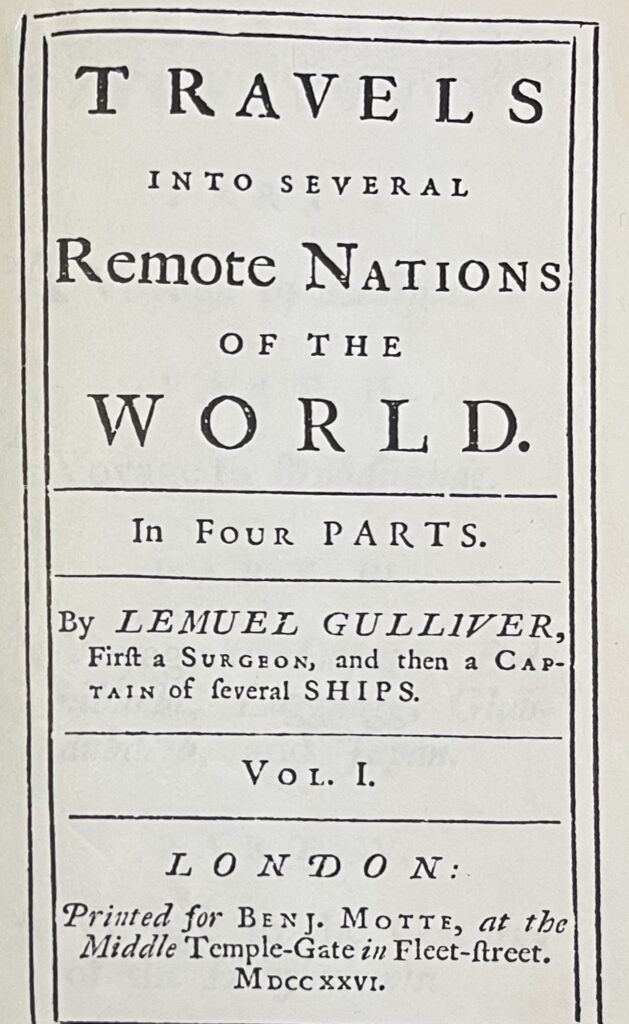
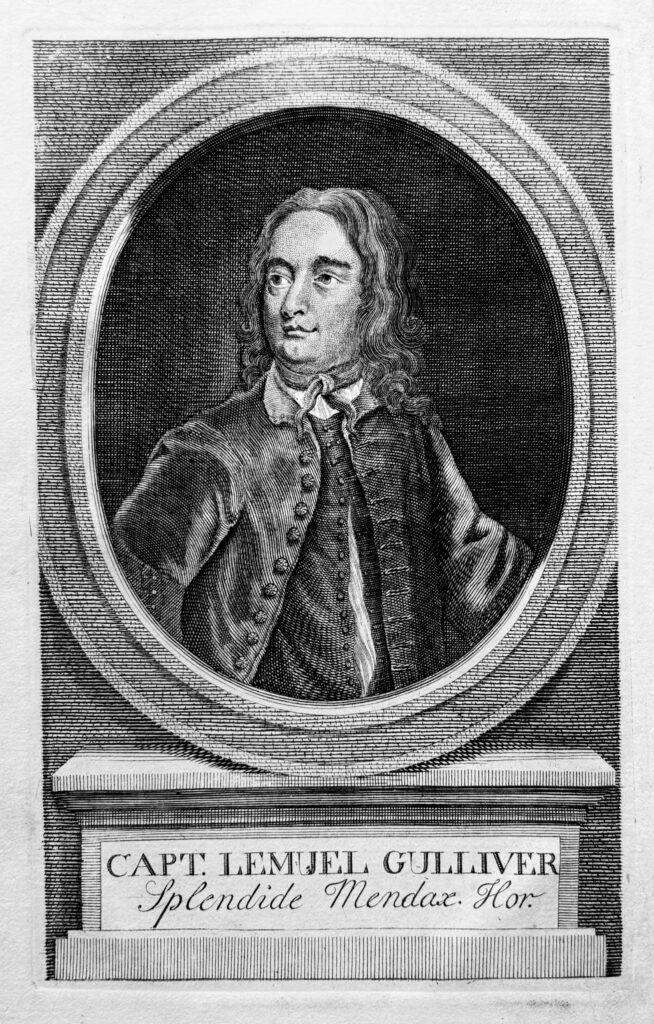
On Friday 28 October 1726 some of the bewigged gentlemen sipping their coffee in London’s fashionable coffee-houses may have had their curiosity piqued by an advertisement in the Daily Journal proclaiming that ‘This day is published Travels into several remote nations of the world. In four parts. By Lemuel Gulliver, first a surgeon and then a captain of several ships’—now universally known simply as Gulliver’s Travels. At first glance Gulliver’s Travels appeared to be another, purportedly true, travelogue recounting the adventures, observations and knowledge gained during four voyages over sixteen years by the hitherto unknown Lemuel Gulliver. The brisk, matter-of-fact, almost bureaucratic writing style of Travels reinforced its apparent authenticity. Over the course of his travels, Gulliver described the political and social regimes of various ‘remote nations’: Lilliput, a disputatious warmongering kingdom inhabited by miniature people; Brobdingnag, a benign monarchy inhabited by giant people; Laputa, a flying island governed by tyrannical philosophical dreamers; and the Country of the Houyhnhnms, dominated by rational horses and infested by hordes of Yahoos, savage humanoid creatures.
We now know that Lemuel Gulliver was not the author of Gulliver’s Travels and that, except for Japan, none of the ‘remote lands’ described exist. Within weeks (almost) everyone in 1726 also knew that the author was Jonathan Swift, dean of St Patrick’s Cathedral, Dublin. Swift went to great lengths to hide his authorship of Travels; he had the text (c. 100,000 words) transcribed by a clerk so that the printer and the authorities would not recognise the handwriting. He sold the English copyright to the leading London printer Benjamin Motte for £200, the only occasion in Swift’s writing career when he was paid a fee.
BEST-SELLER
Gulliver’s Travels was an immediate best-seller. On 7 November his friend John Gay informed Swift, already back in Dublin, that
‘… about ten days ago a Book was publish’d here of the Travels of one Gulliver, which hath been the conversation of the whole town ever since: The whole impression sold in a week; and nothing is more diverting than to hear the different opinions people give of it, though all agree in liking it extreamly. ’Tis generally said that you are the Author, but I am told, the Bookseller declares he knows not from what hand it came. From the highest to the lowest it is universally read, from the Cabinet-council to the nursery.’
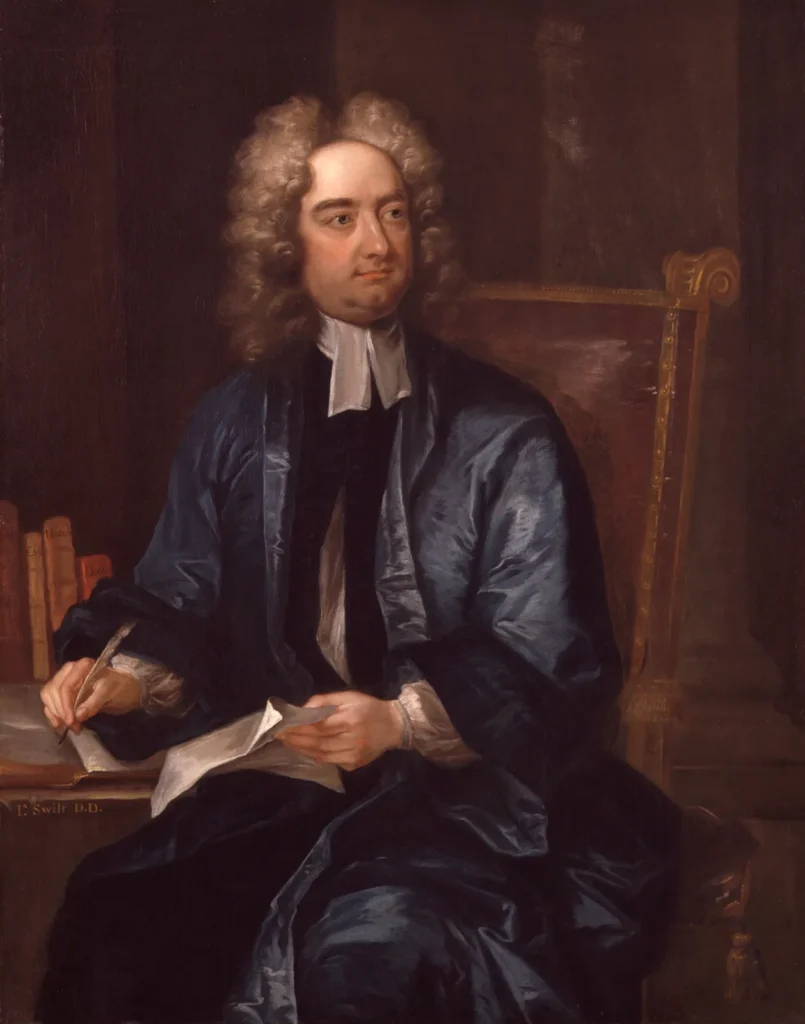
By the end of 1726 Motte had already issued a second imprint. In Dublin John Hyde, Swift’s printer, had published an edition, which boasted that ‘In this impression, several errors in the London edition are corrected’. In short order the still-burgeoning afterlife of Gulliver’s Travels generated a slew of memes, keys, poems, criticisms, letters to the press and, over time, derivatives such as fake sequels, prequels, adaptations, summaries, abridgements and translations, and in later centuries movies, podcasts and TV series. Even AI can’t estimate how many editions of Gulliver’s Travels have been published, but it runs into the thousands. There is no doubt that Gulliver’s Travels is the most-published, and the most-commented-on, book by an Irish author.
SUBSEQUENT COMMENTARY AND CRITICISM
For three centuries Travels has had a profound influence on generations of academics, literary critics, historians and literary figures. Yeats quipped that ‘Swift haunts me; he is always just round the next corner’. George Orwell, who despised Swift’s politics, concurred with Swift’s forewarnings of the dangers of one-party state totalitarianism, replete with show trials and a network of informers. Orwell listed Gulliver’s Travels as one of ‘six books which were to be preserved when all others were destroyed’. For two centuries criticism of the book was primarily directed at Swift’s misanthropic take on humanity and his representation of the Yahoos as avatars of the reality of human nature. In 1851 William Makepeace Thackeray, in a wonderfully over-the-top piece of (absurd?) overstatement, described Swift’s conclusion as ‘filthy in word, filthy in thought, furious, raging, obscene … past all sense of manliness and shame’—a case of shooting the messenger! Thackery couldn’t acknowledge that human weakness, pride and hubris and the resultant violence and social chaos were the problem rather than Swift’s unflattering satiric commentary. For Swift, ‘satire is a sort of glass, wherein beholders do generally discover everybody’s face but their own’. Clearly Thackery hadn’t got the memo! For three centuries Gulliver’s Travels has often been presented in books and in comics, and then in movies and cartoons, as a children’s adventure story. But Gulliver’s Travels is most decidedly not a children’s adventure story.
What sort of person could write a book like Gulliver’s Travels? For William Makepeace Thackery and his nineteenth-century Victorian confrères, the answer was clear. Swift’s savage misanthropy was a sign of his irredeemable irreligious madness; his dementia at the end of his life was the well-deserved judgement of Providence. Twentieth- and 21st-century responses have been more positive, varied and nuanced, ranging from heavily inflected Freudian interpretations to feminist, religious/moralist, philosophical and political theory interpretations. The twentieth century also saw a long-overdue recognition of the Irish dimension of Swift’s thought.
SWIFT AS SATIRIST
Why write such a book? In the mid-1720s Swift was luxuriating in the success of his pivotal role as M.B. Drapier in the Wood’s Halfpence affair, where a united front of Irish Protestants, Catholics and Dissenters had defeated a high-handed and potentially economically crippling coinage imposition emanating from the imperial centre in London. For some, Swift was the ‘Hibernian Patriot’; for others he was the ‘Copper Farthen Dean’. Swift loved the limelight; it vindicated his sense of self-worth and undoubtedly it strengthened his resolve to ‘vex the world’. Swift had form when it came to vexing the world. In 1704 he had published A Tale of a Tub, a hard-hitting but much-criticised and career-limiting satire on modern learning and religious disputation. The Tale had the wonderfully satiric subtitle ‘Written for the Universal Improvement of Mankind’, a sentiment that was both a joke and a serious aspiration. In 1711 his Conduct of the Allies had played a not-insignificant part in ending the long-running and bloody War of the Spanish Succession. Swift was a player and he relished being close to the action. By 1720, however, following the arrival of the Hanoverian Whig regime in London in 1714, Swift was long out of favour and exiled in Ireland. He hit on the idea of using the travelogue genre as a way of expressing his controversial views on major themes such as corrupt political governance and tyranny, religious disputes, abuse of the law, his fiercely anti-war sentiments (there is no glory in war, just death), colonialism and ultimately on inter-species relations and genocide. The travelogue genre allowed him to deploy his unrivalled satirical rhetorical writing style in a series of comic and instantly memorable set pieces. For Swift, Travels was not limited by his own time and place; rather it was written as a universal comment on humanity—‘The same vices, and the same follies, prevail everywhere’.
LILLIPUT
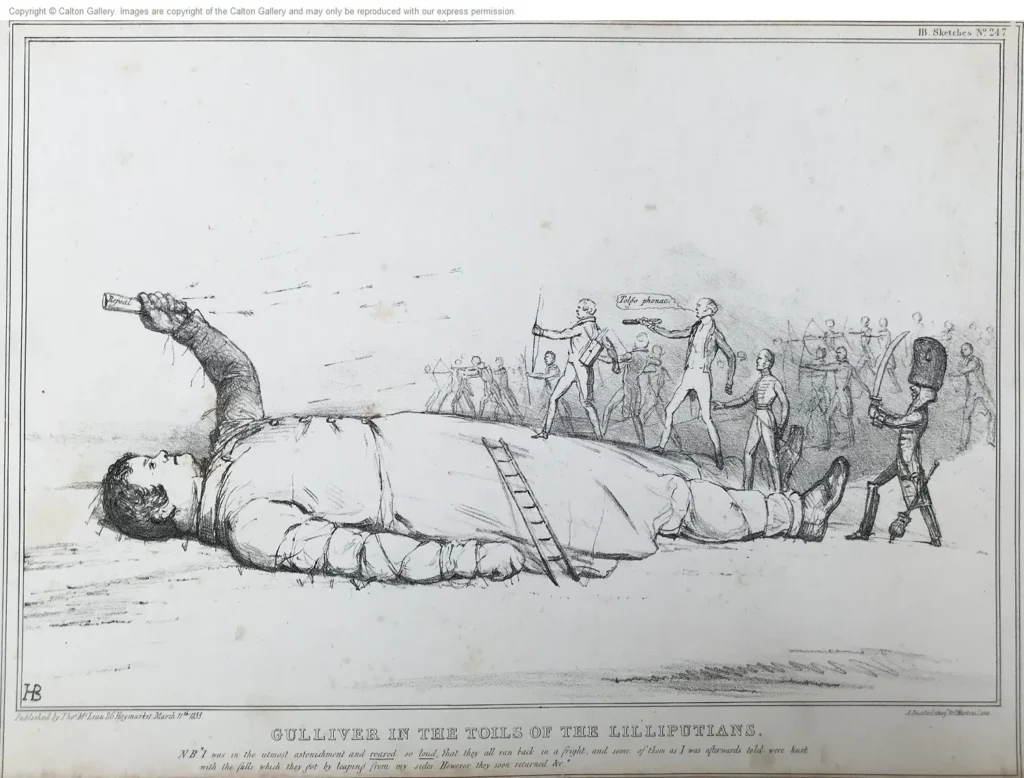
Lilliput may be the best known and the most frequently illustrated part of Gulliver’s Travels. The image of Gulliver tied down on the beach and surrounded by tiny figures is universal. The 1833 image of Daniel O’Connell tied down by malevolent puny forces of resistance and reaction is a classic example (p.18). When Gulliver’s giant size allowed him to assist the Lilliputians by capturing half the fleet of their ‘forever war’ enemy, Blefuscu, the Lilliputian emperor tasked him with capturing the remainder to reduce ‘the whole empire of Blefuscu into a province, and governing it, by a viceroy’. Gulliver demurred, refusing to become a weapon of mass destruction and declaring that ‘I would never be an instrument of bringing a free and brave people into slavery’. The parody of the consequences of disputes over small differences which then result in schism and perpetual civil war is one of Swift’s most ingenious, comic and satiric set pieces. In Lilliput low heels and high heels are presented as defining political markers, and the religious schism concerns at which end to crack one’s egg at breakfast. Gulliver reported:
‘It is computed that eleven thousand persons have at several times suffered death, rather than submit to break their eggs at the smaller end. Many hundred large volumes have been published upon this controversy.’
The dispute resulted in a ‘schism in religion’, as the prohibition offended ‘against a fundamental doctrine of our great prophet Lustrog, in the fifty-fourth chapter of the Blundecral (which is their Alcoran)’. Gulliver continued: ‘This, however, is thought to be a mere strain upon the text; for the words are these: “that all true believers break their eggs at the convenient end”.’ For Christians this joke is borderline blasphemy. No wonder some readers didn’t want, and still don’t want, to heed the message.
BROBDINGNAG
In Brobdingnag the scale is reversed: Gulliver is tiny and the Brobdingnagians are giants. Swift takes full advantage of the comic potential of this by subjecting Gulliver to a series of mishaps with rats, frogs, wasps, dogs, hawks and monkeys. To compensate for the disdain of the Brobdingnagians—how can such a puny creature be taken seriously?—Gulliver ‘ingratiated’ himself with the king by relating exaggerated tales of English and European prowess in ‘the most advantageous light’, i.e. by lying. Gulliver topped off one speech with a grotesque, bloodthirsty and callous description of the destructive power of gunpowder, hitherto unknown to the Brobdingnagians. Gulliver was fulfilling a tyrant’s ‘lord of the world’ dream scenario. The king was horrified, declaring that ‘I cannot but conclude the bulk of your natives to be the most pernicious race of little odious vermin that nature ever suffered to crawl upon the surface of the earth’. Gulliver was shocked at such naïveté, ascribing it to the ‘miserable effects of a confined education’ and ‘A strange effect of narrow principles and views’. For Swift, war was always bad news!
LAPUTA
In Laputa Gulliver encountered a tyrannical regime based on a flying island and run by philosophical dreamers who colonially exploited their subject lands below. At the first signs of resistance, the flying island would hover over the rebels, threatening to crush them or to drop great stones from the air (carpet bombing), and to block out the sun, depriving them of life-giving warmth and rain. The final comic set piece in Book III is the Word Machine, ‘a project for improving speculative knowledge, by practical and mechanical operations … where the most ignorant person, at a reasonable charge, and with a little bodily labour, might write books in philosophy, poetry, politics, laws, mathematics, and theology, without the least assistance from genius or study’. Gulliver reported how ‘the professor showed me several volumes in large folio, already collected, of broken sentences, which he intended to piece together, and out of those rich materials, to give the world a complete body of all arts and sciences’—a hellish vision of the hallucinations of AI slop in one sentence, 300 years avant la lettre!
COUNTRY OF THE HOUYHNHNMS
Finally, Gulliver found himself in a land run by rational horses called Houyhnhnms. This was a simple, peaceful, non-messy interpersonal world, replete with civilised conversation and poetry, their only art form. One result was a complete lack of disputes, or even of differences of opinion, on anything. The notion of ‘alternative facts’ was totally beyond them, and they had no concept of lying; the best that they could do was ‘saying the thing, which was not’. The result was an atheistic, boring, smug, self-satisfied and unfulfilling world, which the Houyhnhnms planned, and indeed hoped, would continue unchanged forever—perhaps Swift’s view of an eternal hell on earth. For the Houyhnhnms Gulliver is a problem; he looks like a Yahoo, he walks like a Yahoo, but he can talk and he has some element of reason—a superior specimen of Yahoo, perhaps. But Yahoo he was, and once a Yahoo always a Yahoo, and Yahoos have few, if any, redeeming features. Gulliver likewise came to realise that he, and therefore all of humanity, are Yahoos. For Gulliver this admission was so disturbing that he became mad in his futile efforts to emulate the equanimity of the Houyhnhnms. The last that we see of Gulliver is a forlorn, deluded, solitary figure talking to his horses, who ‘understand me tolerably well’. Gulliver’s arrival transformed the Houyhnhnms’ Yahoo problem into an existential crisis. They feared that Gulliver as a superior Yahoo might lead a Yahoo revolt and so they expelled him. They then debated the grand question of whether ‘the Yahoos should be exterminated from the face of the earth’ as a final solution to the Yahoo problem. To them this was not genocide but merely a matter of pest control; it’s a dirty job but someone’s got to do it.
At the end of Gulliver’s Travels the reader may be frustrated and confused, i.e. vexed. Every memorable set piece may have a comic element, but Swift then catastrophises the implications of the issue in question. Swift ultimately declared that deep down all humans are Yahoos and therefore flawed—a manifestation of original sin! This final misanthropic message makes Gulliver’s Travels, and its author, Jonathan Swift, still relevant after 300 years; he continues to ‘vex the world rather than divert it’.
Brendan Twomey, a retired banker, is general editor, and introduces, the commemorative limited edition of Gulliver’s Travels which will be published shortly by the Lilliput Press.
Further reading
D. Cook, Gulliver’s afterlives: 300 years of transmedia adaptation (London, 2026).
D. Cook & N. Seager (eds), The Cambridge companion to Gulliver’s Travels (Cambridge, 2024).
D. Womersley (ed.), The Cambridge edition of the works of Jonathan Swift: Gulliver’s Travels (Cambridge, 2012).